Are Military-Style Tents Big Enough for a Family of Four?
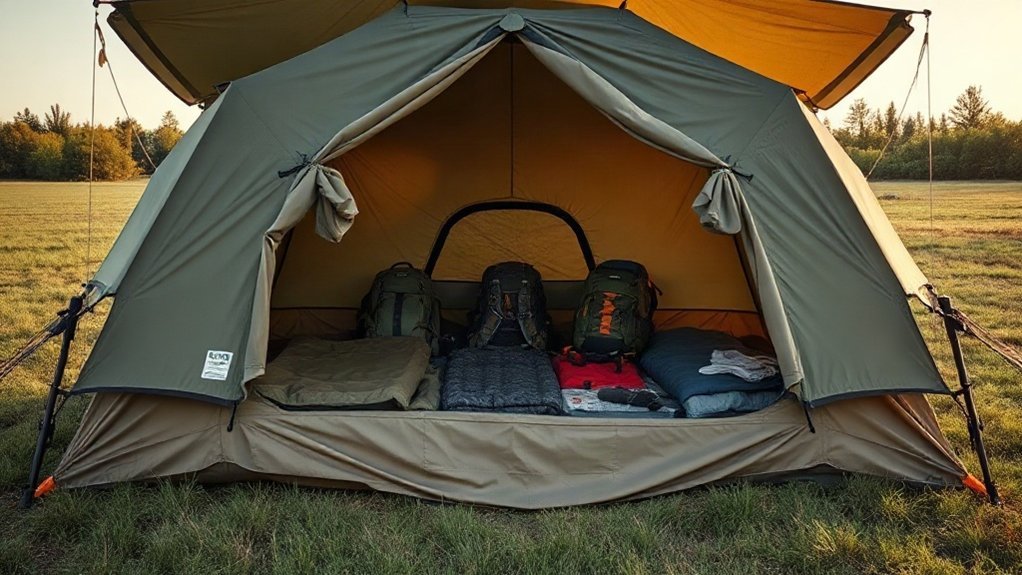
I wouldn’t assume a military-style tent rated for four will comfortably fit a family of four. Ratings often mean people sleeping close together, with little room for airbeds, clothing or packs; I’d plan for roughly half the advertised capacity when bringing beds and gear. Check floor dimensions, headroom and storage space, too. A roomy Lavvu may suit longer stays, while a lighter Yukon 4 works better for weekends. I’ll explain how to judge the trade-offs and choose a practical shelter.
Key Takeaways
- Military-style capacity ratings are maximums; for family comfort, plan on roughly half the stated capacity when bringing beds and gear.
- Check floor dimensions, headroom and storage space: the four-person Marmot Tungsten is tight for two adults and two children.
- The eight-person Swedish Army Forest Patrol Lavvu is rated comfortable for five, giving a family of four useful room for sleeping gear.
- Choose a roomy canvas shelter for longer stays; lighter polyester tents like the Yukon 4 suit quick weekends but offer less space.
- Before buying surplus, check packed weight, frame completeness, seams and waterproofing, then test-pitch the tent before your trip.
Are Military-Style Tents Big Enough for Four?
Yes, but don’t rely on the advertised capacity alone. I’d check the floor plan, headroom and space for gear before choosing military-style tents for your family. Ratings often assume tightly packed occupants with kit, so I’d plan for roughly half the stated capacity if you want room for airbeds, a cot and belongings.
For a family of four, the Swedish Army Forest Patrol Lavvu offers a roomy option: it’s rated for eight but described as comfortable for five, leaving your family space to move and even fit a wood stove. If you’d rather pitch quickly and carry less, the Yukon 4 Person Tent with Fly Sheet can fit four with room for gear.
A two-person French Army F2 won’t work as your main shelter, but it could give an older child a separate den nearby. For group camping or a flexible base camp, I’d match the tent to how you want to sleep, store equipment and move around—not just the number on its label. Advertised capacities can be optimistic, so account for packs and boots when judging usable space.
Why Do Tent Capacity Ratings Mislead Families?
Tent capacity ratings usually count how many people can sleep close together, not how comfortably a family can live in the tent. I treat the number as a maximum, often based on sleepers lying side by side with their kit tightly packed. It doesn’t promise room for belongings, headroom, or a place to spend time indoors when weather keeps you inside.
As a practical guide, I plan for about half the stated capacity when I need space for airbeds, a camping cot, and gear. An eight-person Lavvu, for example, is described as comfortable for five. Before buying, I check floor dimensions, usable headroom, the layout, and whether a porch can hold boots and bags. I also check how a groundsheet or tent footprint fits the floor, since neither creates extra living space. A four-person rating may fit your family, but it doesn’t guarantee comfort. A small French Army F2 is better treated as an older child’s add-on shelter than a family tent. Canvas wall tents with steel poles can weigh well into double-digit pounds, making them better suited to base camps and vehicle trips than long hikes.
How Much Room Do Four People Need?
I’d plan for more than four sleeping-bag spaces so you can fit airbeds or a cot without crowding. You’ll also need room for bags and everyday gear. I’d check floor area, headroom, and porch space rather than relying on the tent’s capacity rating. A shared shelter gives four people room to sit and sleep together while making setup easier.
Sleeping Space Needs
How much room do four people need? I’d treat a tent’s capacity label as a close-packed maximum, not a promise of comfortable sleep. For four people, look for a model rated for eight; that leaves room to spread out sleeping pads or use a cot. An eight-person Swedish Army Forest Patrol Lavvu, for example, is described as comfortable for five, giving a family more freedom to arrange its sleeping setup.
Check floor area and the usable layout, too. The Marmot Tungsten 4 offers 4.9 m² (52.7 sq ft), but its four-person fit is tight for two adults and two children. A Yukon 4 can accommodate four with room for gear, while a roomy canvas wall tent lets each person place a sleeping bag without crowding.
Room For Gear
Where will everyone’s gear go once the sleeping bags are down? I’d plan for clothing, packs, airbeds or a cot, and other essentials—not just four bodies. Military capacity ratings often assume soldiers sleep close together and keep kit tightly packed. For family camping, I use about half the stated capacity as a practical guide.
That makes an eight-person Swedish Army Forest Patrol Lavvu a roomy choice: it’s described as comfortable for five, leaving a family of four space for belongings. The Yukon 4 Person Tent can also fit four with gear. I’d reserve the two-person French Army F2 for a kids’ den, not the main shelter.
Check usable floor and porch space, then assess portability. A military surplus tent may weigh two to three times as much as modern nylon, competing with your camp kitchen for car space.
Which Military-Style Tents Suit Families?
Military capacity ratings are maximums, so I’d allow roughly half the stated capacity for a comfortable family setup with airbeds, a cot and belongings. For a family of four, I’d start with the Swedish Army Forest Patrol Lavvu: rated for eight and comfortable for five, it offers useful spare room and costs £600. Its space for a wood stove makes it a practical bunker tent for cold-weather camping, though you’ll need to check the stove setup and ventilation. Its heavy-duty construction is designed for durability in harsh weather, though it adds weight and bulk.
If you want a lighter, quicker-pitching shelter for weekends, the £99.99 Yukon 4 Person Tent with Fly Sheet has room for four and their gear. For longer stays, the £850 Swedish Army Dome Tipi with Wood Stove provides indoor cooking and space to dry wet kit, but takes longer to pitch.
I wouldn’t use the £35 New French Army F2 as the family’s main shelter: at 200 × 150 × 100 cm, it’s too small. It could give an older child a separate den.
Can a Swedish Army Lavvu Fit a Family?
For a family of four, the Swedish Army Forest Patrol Lavvu’s eight-person rating leaves useful room for sleeping gear and belongings, since military ratings assume close-packed occupants. I’d treat that rating as a guide, not a promise of spaciousness.
| Consideration | What to expect |
|---|---|
| Capacity | Rated for eight; comfortable for five |
| Family use | Four have room for gear |
| Shape | A pyramid tent with central space |
| Stove | Room for a wood stove |
| Best use | Longer stays, not quick weekends |
The unissued cotton canvas makes this Lavvu a strong choice for a full campsite week, and the stove option can extend your comfort in cold weather. It can also serve as an emergency shelter, though its weight limits spontaneous trips. Before buying, I’d check packed weight, whether it fits your car boot, and how setup works. If you want freedom to move camp often, that load may feel restrictive; for a settled family base, the extra capacity is useful. Unlike a dome tent that pitches in minutes, this heavier canvas shelter prioritizes weatherproofing and warmth over convenience.
Is the Yukon 4-Person Tent Roomy Enough?
At £99.99, the Highlander Yukon 4-Person Tent offers a budget-friendly option for a family of four, with room for gear as well as sleeping space. Its stated capacity is four, so I’d consider it a practical choice for weekend trips when you want a simple base for sleeping and storing essentials. You won’t get the extra space of a larger surplus tent, but the Yukon can keep your kit inside rather than crowding the sleeping area.
Highlander makes it from 190T PU-coated polyester. The coating supports waterproof protection, though I’d still check the forecast and pitch on suitable ground. For durability, handle the fabric and poles carefully, particularly during repeated use. Compared with larger canvas options, this tent is lighter and quicker to pitch, which can make family outings easier to organise.
A well-fitted footprint should match the tent floor and extend beneath the vestibules without sticking out far enough to collect water.
If you’re new to camping, I’d see the Yukon as a straightforward, affordable gp small tent for short breaks—not a roomy choice for prolonged stays.
When Does a Basecamp Tipi Make Sense?
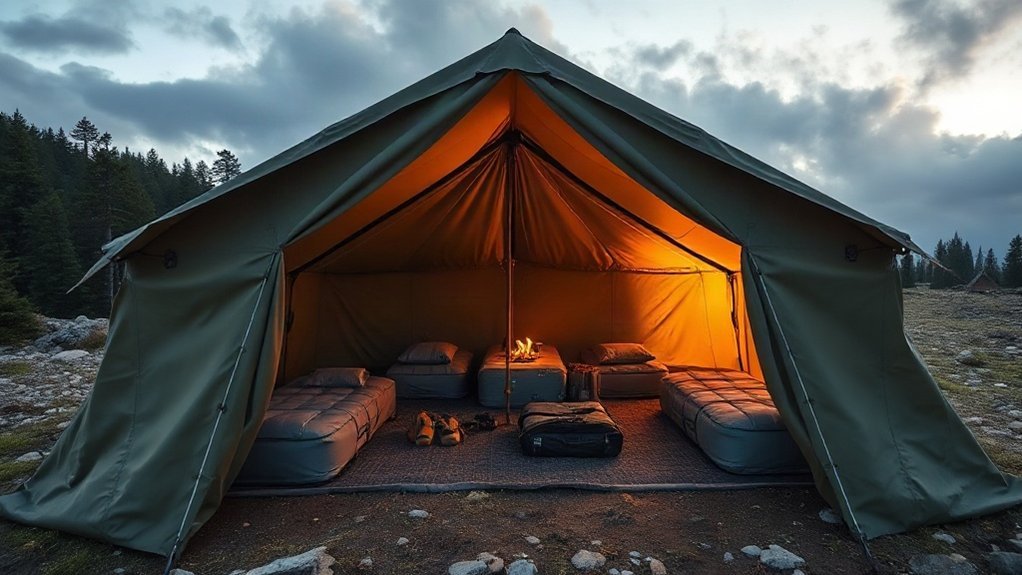
A basecamp tipi makes sense when you’re staying for a week or longer, not just a weekend. I’d choose the $850 Swedish Army Dome Tipi for an extended family camp where cooking and drying wet gear indoors matter. Its wood stove can make a rainy day more comfortable, and the stovepipe provides a practical outlet for smoke. In the backcountry, that setup offers a useful home base, but it takes time to pitch. I’d allow extra time on the first night, especially with children nearby.
These tents are valued for lasting through storms, not just for handling a single weekend of bad weather.
| Trip plan | Better fit | Why |
|---|---|---|
| Quick weekend | Yukon 4 Person | $99.99 and quicker to pitch |
| Week-long stay | Army Dome Tipi | Stove supports cooking and drying |
| Rainy extended camp | Army Dome Tipi | Indoor heat adds comfort |
A tipi also gives your group room to settle in and arrange a windbreak around camp. For a short trip, I’d favor the faster tent and spend less time setting up.
How Do Canvas and Polyester Compare?
Canvas suits longer stays because it breathes well and resists UV damage, though it weighs more and may need occasional reproofing. For a family staying at one site, I’d value its comfort and durability over easy carrying. Good canvas care means letting it dry fully before storage and renewing its treatment when needed, especially if the tent is used or older.
Heavy polyester is lighter and dries faster, so I find it easier to handle on quick trips or when I’m moving camp. Unissued and Grade A surplus tents are generally waterproof out of the box; older canvas may need reproofing before a holiday. Check the fabric description: a polyurethane coating helps polyester shed rain, as on the Yukon 4, made from 190T PU-coated polyester. Ripstop nylon is another lightweight fabric, but don’t assume every surplus tent uses it. Both canvas and heavy polyester can last for years and cost less than many high-street alternatives, leaving you free to choose by trip length and load.
What Should You Check on a Surplus Tent?
I check the condition grade and seams first; used or older canvas may need reproofing before a trip. I also judge space by headroom, sleeping layout, and room for boots and gear, not the advertised capacity alone. Finally, I confirm the packed weight and pole system, since surplus tents can be heavy and take longer to set up.
Condition And Reproofing
Before relying on a surplus tent for a family trip, check its condition grade, seams, and waterproofing. Unissued and Grade A tents are generally waterproof out of the box, but I still verify the seller’s grading rather than trust a “new” label. I inspect the fabric for mildew, damage, and signs of wear, then examine seams and door edges for gaps. A Light Fighter tent sold as brand new leaked near a door; seam sealer fixed it. Don’t assume a hydrostatic head rating—or the tent’s age—guarantees protection.
Used or older canvas may need reproofing before a week-long stay. I follow a canvas-specific waterproofing guide and treat it before departure. Avoid unrestored WWII- or Cold War-era bivvy tents for family camping: vintage canvas may need seasoning as well as reproofing. Test the tent in wet conditions before you leave.
Space, Weight, And Setup
Treat a surplus tent’s capacity as a maximum, not a family-friendly headcount: an eight-person model may fit eight soldiers with kit packed tightly, but I’d plan for roughly four once you add airbeds, a cot, and belongings. Check floor dimensions, headroom, and vestibule space for gear and boots before buying.
| Check | What I look for | Why it matters |
|---|---|---|
| Packed load | Weight and boot fit | Surplus tents may weigh two to three times more than modern nylon |
| Frame | Aluminum poles, tension straps | Confirm the system is complete and manageable |
| Pitch | Setup time and instructions | A flysheet pitch is usually quicker than wooden bivi poles |
A modular tent system can offer flexibility, but verify what’s included. The 3.4 kg French Army F2 measures 200 × 150 × 100 cm; I’d use it as an older child’s den, not the family’s main shelter.
How Much Do Weight and Setup Matter?
When comparing military-style tents for a family of four, check both packed weight and pitching time: surplus canvas models can weigh two to three times as much as modern nylon tents, so make sure the tent fits your car and you can carry it.
I’d match the tent to the trip, not just the sleeping capacity. The Swedish Army Forest Patrol Lavvu offers a durable canvas basecamp for a week away, but its weight and slower setup make it less convenient for quick weekends. By contrast, the lighter Yukon 4 Person Tent pitches faster, which can simplify a first family camping trip.
Design affects setup, too. A dome tent usually goes up faster than a tipi or an a-frame tent that relies on traditional wooden bivi poles. You’ll also need time to position and tension guy lines. The Swedish Army Dome Tipi with wood stove takes longer to pitch, so allow extra time on your first outing, especially with young children. A manageable load and straightforward setup leave you freer to enjoy camp.
Frequently Asked Questions
What Is the Best Size Tent for a Family of Four?
I’d choose a tent rated for at least six people for a family of four. Capacity labels often assume close sleeping arrangements and leave little room for bags, so extra space makes trips more comfortable. Check floor area and headroom, not just the rating: a roomy six-person model can fit airbeds or a cot, while many four-person tents feel tight once you add gear. For a compact setup, a four-person tent can work.
What Is the Best Tent for a 4-Person Family?
For most families of four, I’d choose the Yukon 4 Person Tent with Fly Sheet: at £99.99, it’s a practical, quick-pitch base camp with room for gear. If you’re planning a week-long stay and want more breathing room, the Swedish Army Forest Patrol Lavvu is roomier, though heavier, slower to set up and £600. I’d check space for beds and belongings first; capacity labels can be tight when everyone’s inside.
Is a 4 Person Tent Big Enough for 3 People?
Yes, a four-person tent can fit three people, and I’d expect more sleeping room than the rating allows for four. However, you may still find it cramped if you bring bulky bags, airbeds, or a cot, or spend long periods inside during bad weather. For example, the Marmot Tungsten 4 has 4.9 m² of floor space. Its vestibule can hold gear, freeing floor space. For greater comfort, I’d choose a larger tent.
Is a 6-Person Tent Big Enough for 4 Adults?
Yes—a six-person tent can fit four adults, if you enjoy discovering how friendly strangers’ elbows can be. I’d treat that rating as a maximum sleeping-bag count, not a comfort guarantee. Check the floor area, headroom, and vestibule space for beds and gear; military-style tents may feel roomy only at about half their stated capacity. For longer trips or bad weather, I’d choose a larger model, and check its packed weight and car fit.
Conclusion
I’d choose a military-style tent for four only after checking its usable floor space, not its advertised capacity. A compact surplus shelter may sleep four; a roomy lavvu or basecamp tipi can make family life more comfortable, but it takes more space, weight, and setup time. Canvas often feels sturdy yet heavy, while polyester is lighter but may offer less durability. For a family, the best tent isn’t the biggest or toughest—it’s the one you can carry, pitch, and live in comfortably.
References
Tent and Tarp Camping — U.S. Army, *The Warrior Ethos and Soldier Combat Skills*, https://armypubs.army.mil/epubs/DR_pubs/DR_a/ARN30341-TC_3-21.76-000-WEB-1.pdf
Camping — National Park Service, https://www.nps.gov/subjects/camping/index.htm
Camping and Backpacking — U.S. Forest Service, https://www.fs.usda.gov/visit/know-before-you-go/camping