Are Bivy Sacks Comfortable Enough for Taller Campers?

I find bivy sacks can suit taller campers, but height alone doesn’t determine comfort. Compare interior length, shoulder and foot girth, and clearance with your actual pad and sleeping bag or quilt. Lie inside, zip up, and roll both ways; your head and feet shouldn’t press against the fabric, insulation shouldn’t compress, and the zipper shouldn’t strain. If you need more headroom or room to move, a bivy tent may fit better. The checks below can help you choose.
Key Takeaways
- Bivy sacks can suit taller campers, but compare interior length, shoulder girth, and foot girth—not height alone.
- Check that your head, feet, and sleeping bag remain clear of the fabric, with insulation uncompressed and the zipper closing smoothly.
- Test the bivy with your actual pad and sleep system; thick inflatable pads can reduce clearance and make the fit feel tighter.
- Roll both ways while lying down: tapered designs may restrict movement, while hooped or roomier models can improve headroom and comfort.
- If a bivy feels too restrictive, consider custom sizing or a bivy tent, and verify fit before relying on it outdoors.
Are Bivies Comfortable for Tall Campers?
A bivy can be comfortable for a tall camper, but height alone doesn’t determine fit. I look beyond a bivy’s listed length and check shoulder and foot room, sleeping bag loft, and space for my sleeping pad and any gear I’ll keep inside. Those details matter when I want a lightweight shelter that still lets me sleep naturally.
Tall campers report good results with roomy designs. A 6’3″ user found ample space in a Borah Gear Tall/Wide bivy, which weighs 6.1 ounces; the maker also offers custom sizing at no extra charge. A 6’2″, 185-pound camper fit a NeoAir pad, backpack, and summer kit in a 92-inch TiGoat Raven Omni and could turn over. A 6’4″, 225-pound side sleeper liked the Long/Wide Katabatic Bristlecone, though another camper found Regular/Wide adequate.
Inflatable pads, especially thick ones, crowd bivy sacks more than foam pads. I’d test my actual sleep system before relying on a fit. A bivy’s limited living space is part of the tradeoff for a lighter shelter.
Measure Bivy Length Against Your Height
I check a bivy’s usable interior length, not just its listed exterior length, and leave room for my sleeping bag or quilt without compressing its insulation. At 6’2″, I’d compare that space with my height, then test it with my actual pad and sleep system—thicker inflatable pads can reduce clearance. Make sure your head and feet aren’t pressed against the ends and that you can zip the bivy comfortably. Like sleeping bags, a bivy should provide a roomy fit that suits your body size.
Check Bivy Dimensions
Start with the bivy’s usable interior length, not its advertised size, and compare it with your height. At 6’2″, I’d check that my head and feet won’t press against the fabric. The TiGoat Raven Omni measures 92 inches; one 6’2″ camper found it long enough for a sleeping pad, backpack, and summer kit. A 6’3″ camper reported ample room in Borah Gear’s 6.1-ounce Tall/Wide bivy, and Borah offers custom sizing at no extra charge.
I’d test dimensions with my actual pad and sleep system before choosing. A thick inflatable pad can reduce usable space, make a hooped bivy feel shorter, or complicate zipping. I’d also weigh interior room against tarp coverage: a longer bivy may extend beyond the rain protection. Check pack size and shelter fit together.
Allow Extra Length
Choose a bivy with enough usable interior length that your head and feet won’t press against the fabric. I compare the listed interior length with my height, then leave extra room for my pad and sleep system. At 6’2″, one camper found a 92-inch TiGoat Raven Omni long enough for a pad, backpack, and summer kit. Another, at 6’3″, had ample space in a 6.1-ounce Borah Gear Tall/Wide bivy. These examples offer a starting point, not a guarantee: fit changes with your gear. An inflatable or thick pad can make a bivy feel shorter and harder to zip than a foam pad. Before choosing this minimalist alternative to a one-person tent, I’d test it with my actual pad and camp quilt. Extra room may limit rain protection under a small tarp.
Allow Room for Your Pad and Sleeping Bag
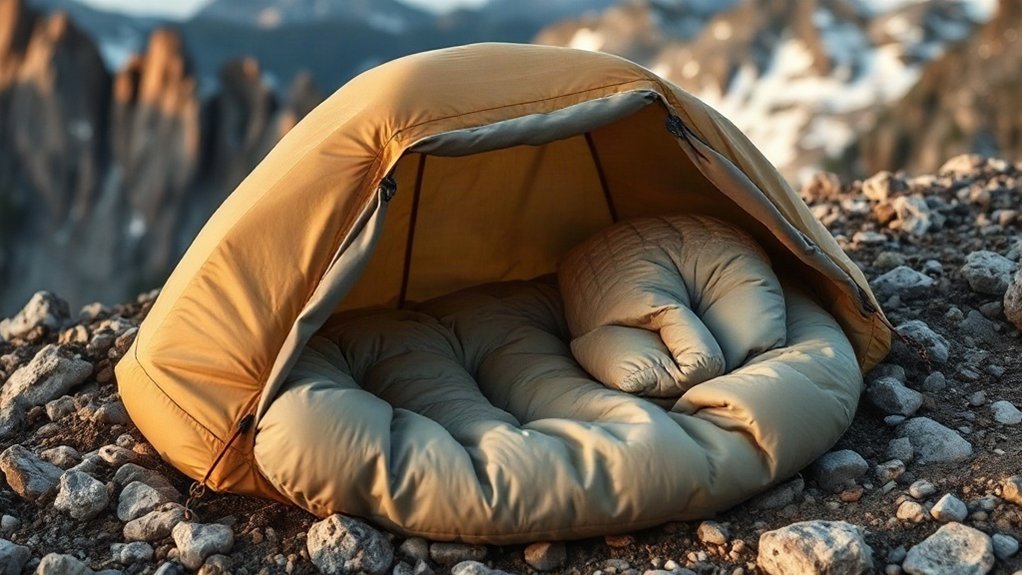
I check a bivy’s usable length and shoulder and foot girth with my actual pad and sleeping bag, because that full setup determines the room you’ll have. An inflatable or thick pad can press against the top fabric or make the zipper hard to close, while a tight fit can compress your bag’s loft. Before a trip, I test the exact setup and make sure you can zip the bivy, move comfortably, and leave the bag uncompressed. A bivy’s quick pitch and compact size can be useful on fast, fair-weather trips, but a tent offers more room to sit and wait out rain.
Account for Pad Thickness
A bivy that fits over a thin foam pad may feel cramped with an inflatable pad, which takes up more room in both height and width. I check the fit using the pad I’ll actually carry, not a foam substitute. A thick pad can push the sleep system against the bivy’s upper fabric and make the zipper hard to close.
Before solo camping, I test the complete setup on a groundsheet. I zip the bivy, roll over, and move as I would overnight, checking that the pad doesn’t restrict movement. As a taller camper, I also leave room beyond my body length; the pad can reduce space around my shoulders and feet. If I’ll store a pack inside, I include it in the test.
Check Sleeping Bag Loft
Will your sleeping bag still loft inside the bivy? I test the shelter with my actual bag or quilt and pad before a trip. A close shell can compress insulation, cutting warmth and comfort. Inflatable pads, especially thick models, occupy more room than foam pads and may make the zipper hard to close. For a reliable check, I:
- Set up the bivy pitch on level ground.
- Add the pad and sleeping bag I’ll use.
- Lie down and zip the bivy fully.
- Check loft at my shoulders, sides, and feet.
- Try another size or model if the shell presses on the bag or the zipper strains.
As a taller camper, I check interior volume as well as length. Extra length won’t help if my pad and bag cannot fit without compression.
Allow Extra Interior Space
Because advertised height doesn’t tell you how much room you’ll have, check a bivy’s usable length and its shoulder and foot girth. At 6’2″, I’d test the bivy with my actual pad and sleeping bag before heading out. A thick inflatable pad takes up more space than closed-cell foam and can make zipping difficult. I’d also leave room for my bag or quilt to loft without pressing against the walls; a tight fit can restrict turning. A two-pole bivy may offer useful space, but I’d compare its interior dimensions rather than assume its design guarantees comfort. If I plan to store gear inside, I’d include that in my fit test. Extra room needn’t mean a bulky tent footprint: custom sizing can preserve freedom on ultralight backpacking trips.
Check Shoulder and Footbox Clearance
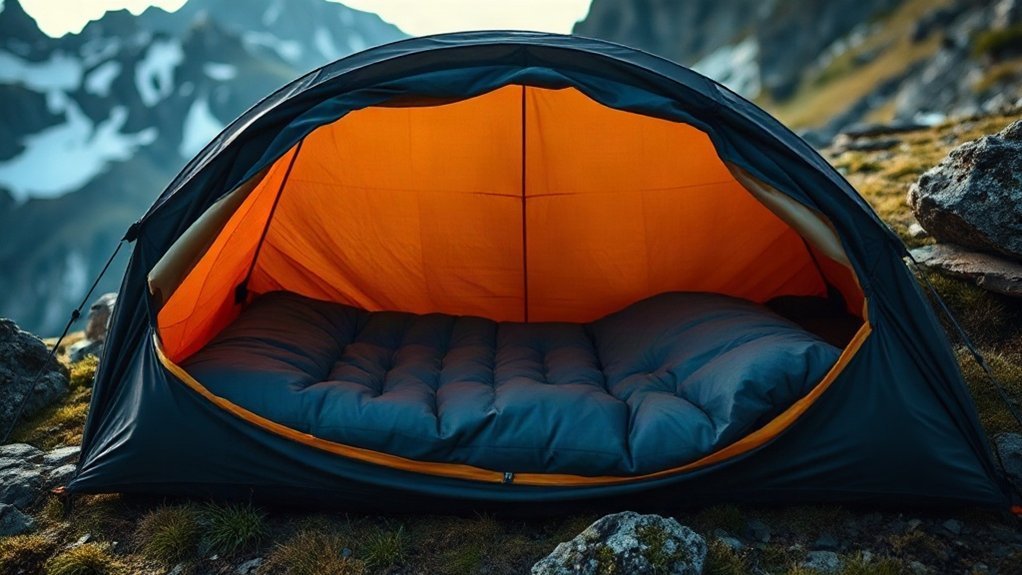
Check clearance with your actual sleeping bag and pad, since listed length alone won’t show whether the footbox compresses insulation or the top fabric crowds your shoulders. At 6’2″, I’d check both dimensions and test the setup before relying on it for a cold night. A breathable bivy won’t help if tight fabric compresses your bag.
- Lie on your back and confirm your feet don’t press into the footbox.
- Check shoulder room with your usual pad; thick inflatables raise you closer to the top fabric than foam pads.
- Close the zipper fully without pulling fabric taut or straining the closure.
- Roll both ways and note whether the bivy shifts or restricts your sleeping bag.
- Compare girth measurements: one 6’2″, 185-pound camper found the TiGoat Raven Omni’s 76-inch chest and 60-inch foot girths comfortable.
A 6’3″ camper reported ample length in the 6.1-ounce Borah Gear Tall/Wide, which offers custom sizing at no extra charge. I’d test at home, then pack it in its stuff sack only after confirming clearance. A thicker pad can raise your shoulders closer to the bivy’s top fabric, so check pad thickness along with shoulder clearance.
Choose a Bivy Shape That Lets You Move
I compare usable length and shoulder and foot girth with my body, sleeping bag, and pad, since listed height alone won’t tell me if I can turn. A tapered bivy can save weight but restrict movement, and a thick inflatable pad may make it harder to zip than a foam pad. I test my exact setup by rolling both ways and checking that my bag isn’t compressed. Like a wide hammock, a bivy with enough room across the shoulders can make it easier to settle into a comfortable diagonal lay.
Allow Room to Turn
Even when a bivy is long enough, a narrow cut can restrict turning, so compare its chest and foot girths as well as its listed length. I’d choose a roomier bivy sack if you sleep on your side or toss and turn. Check these points:
- Compare chest girth for shoulder and torso clearance.
- Check foot girth; a tapered end can limit movement.
- Allow for an inflatable pad, especially a thick one, which uses more space than foam.
- Test your own pad and sleep system inside the bivy.
- Roll both ways; reject a fit that presses fabric against you or compresses your sleeping bag.
One 6’2″ camper turned comfortably in a TiGoat Raven Omni, measuring 92 inches long with a 76-inch chest girth. I’d assess fit alongside durability and ventilation, not length alone.
Match Shape to Sleep Setup
When you choose a bivy shape, match its usable length and shoulder and foot girth to your body, sleeping bag, and pad—not just your height. At 6’2″, I’d check those dimensions carefully: an inflatable pad sits higher than CCF foam and can make a thick setup harder to zip. The TiGoat Raven Omni measures 92 inches long, with 76 inches of chest girth and 60 inches at the foot; one 6’2″, 185-pound camper fit a NeoAir and summer kit. If you sleep on your side or toss, I’d consider a wider cut. A 6’4″, 225-pound side sleeper found the Long/Wide Katabatic Bristlecone comfortable with an Exped UL mat. Test your full setup: roll over and zip without compressing your bag. Extra room may reduce rain cover beneath a small tarp shelter; factor that into campsite selection and trekking pole tarp height.
Compare Roomy and Lightweight Bivies
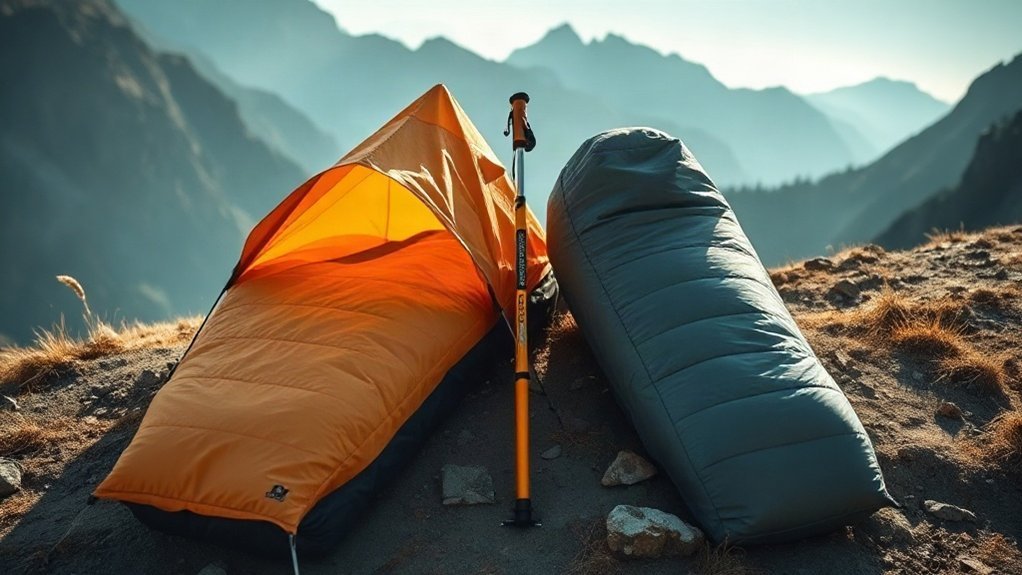
If you prioritize low weight, the 92-inch TiGoat Raven Omni weighs under 10 ounces and offers enough girth for a pad and some gear; Borah Gear can also custom-size a bivy at no extra charge, and one 6-foot-3 camper found its 6.1-ounce Tall/Wide model ample.
Prioritize low weight with the under-10-ounce TiGoat Raven Omni or a custom-sized Borah Gear bivy.
For thru-hiking, I’d compare packed weight with usable floor space, then test the bivy with your actual sleep system. A silnylon shelter may suit a quick pitch, but a close-fitting bivy can restrict movement. To reduce clamminess, open the mesh panel or entry to improve airflow and limit condensation.
- TiGoat Raven Omni: 76-inch chest and 60-inch foot girths accommodate a pad and some gear.
- Borah Gear Tall/Wide: Custom sizing costs no extra; one tall user found it ample.
- Black Diamond Twilight: At 10.7 ounces and 8 × 13 cm packed, it’s compact, but users report a tight fit, limited torso room, and a short zipper.
- Sierra Designs Backcountry Bivy: At 0.9 pound, it offers 16.7 square feet, a U-shaped opening, and guy-out points that lift the ceiling.
- Check your setup: Inflatable pads need more space than CCF pads; confirm shoulder and foot room, and avoid compressing your sleeping bag.
Check Headroom and Face Clearance
A roomy floor and low packed weight won’t help if the bivy presses against your face. At 6’2″, I check usable length plus shoulder and foot girth; listed height alone won’t show whether the shelter feels cramped. Headroom matters too. A hooped design, such as the Snugpak Stratosphere, uses intersecting poles to lift fabric away from your face. A hoop pole can make turning and breathing feel less restricted than in a simple sack.
I also look for a mesh bug net that protects against insects while keeping solid fabric clear of my face. Guy-out points, like those on the Sierra Designs Backcountry Bivy, raise the ceiling; its U-shaped opening also makes entry and exit easier. Before buying, I lie inside, roll both ways, and check that the opening stays clear. I value a bivy that shields me without making movement or airflow feel confined. Its low packed weight and pole-free setup make it a practical lightweight shelter, especially when paired with a small tarp for a dry place to sit and cook.
Test the Fit With Your Sleep System
Test the bivy with the exact pad, quilt or sleeping bag, and insulation you plan to use, since thicker inflatable pads can leave less room and make the zipper harder to close. I inflate my pad fully before climbing in, then check entry and closure; an empty bivy can feel roomy but become restrictive with gear inside.
Test your bivy with your fully inflated pad and planned sleep system to check fit and ensure the zipper closes smoothly.
- At 6’2″, I check usable length so my head and feet don’t press against the fabric.
- I lie down and roll both ways to assess shoulder and foot room.
- I check whether my quilt or bag touches the walls; contact can increase dampness and condensation.
- I operate the waterproof zipper with the pad inflated to confirm it closes smoothly.
- I note whether extra length affects rain coverage beneath my tarp.
A 6’3″ camper found ample length in a 6.1-ounce Borah Gear Tall/Wide, while a 6’2″, 185-pound camper found the 92-inch TiGoat Raven Omni roomy with a NeoAir, backpack, and summer kit. I also inspect event fabric for contact points before settling in.
When Does a Bivy Tent Fit Better?
When a close-fitting bivy sack still feels cramped, a bivy tent can give you more headroom and floor space. I’d consider one when you want extra face clearance, easier entry, or room to stash a pack in a vestibule. Poles hold up a raised canopy, giving you more freedom to move without stepping up to a regular tent.
Check the listed interior length and height before buying; floor area alone won’t tell you whether you’ll fit comfortably. The Winterial Single Person Personal Bivy Tent offers 17.5 square feet of floor area and 3 feet 2 inches of height. The Eureka! SOLITAIRE AL has 21.5 square feet of floor area but only 2 feet 4 inches of peak height. That added structure comes with weight: the Winterial weighs 2 pounds 9 ounces. For mountaineering, weigh that trade-off against space. A waterproof bivy tent still won’t provide sit-up room, and an emergency blanket won’t change its dimensions.
Avoid Common Bivy Fit Problems

To avoid a bivy that feels cramped, compare its usable length and shoulder and foot girth with your height, sleeping bag, and pad—not just the published dimensions. I’d check the complete sleep system before choosing a size, especially for long trips on the appalachian trail or pacific crest trail.
Compare a bivy’s usable length and girth with your height, pad, and sleeping bag before choosing a size for a long trail.
- If you’re tall, consider tall sizing or custom dimensions. One 6′3″ camper found a Borah Gear Tall/Wide roomy enough; a 6′2″ camper fit the 92-inch TiGoat Raven Omni.
- Allow extra space for an inflatable pad, particularly a thick one. It can press against the top fabric and obstruct the zipper.
- Test your actual pad, bag, and bivy together before heading out.
- Zip up, move, and roll both ways; make sure the shell doesn’t compress your sleeping bag.
- Don’t size up blindly: excess room may feel claustrophobic and make the bivy harder to manage.
For snow camping, this fit check matters even more when bulky insulation fills the shelter.
Frequently Asked Questions
What Are the Key Differences Between a Bivy Sack and a Sleeping Bag?
A sleeping bag insulates you; a bivy sack adds a protective outer layer. I use a sleeping bag for warmth, while a bivy shields it and your pad from ground contact, wind, splashes, and sometimes precipitation. A bivy doesn’t replace insulation, and a sleeping bag isn’t weatherproof or an insect shelter. Check that your bag fits inside the bivy without compressing its loft, and confirm which features its fabric provides.
Are Bivy Sacks Worth It?
Yes, I think a bivy sack’s worth it when you want a lighter, more compact shelter—not because it’s roomy. Some models weigh under 10 ounces, making them useful when every ounce matters. Don’t assume a tall camper can’t fit: I’d check the exact length and test your sleeping bag and pad inside, since thick pads and lofty bags reduce space. If you want room to move or wait out storms, I’d choose a tarp or tent instead.
How Much Warmth Does a Bivy Sack Add?
I’d expect a bivy sack to add a few degrees of warmth by trapping heat around your sleeping bag, but the gain varies with its design, weather, and fit. A snug shell can help, yet if it compresses your bag’s loft, you may lose insulation. Waterproof models can feel warmer but trap moisture. I’d choose breathable fabric and vents, pair the bivy with a suitable pad and bag, and test your setup before cold trips.
Can You Sleep in Just a Bivvy Bag?
Yes, you can sleep in just a bivvy bag on a suitable night, provided it fits your sleeping bag or quilt and pad and protects you from the ground, wind, and weather. I’d keep my pack and boots outside but within reach, since a bivvy isn’t a place to sit up or store gear. For bugs, I’d choose a mesh hood. In rain, I’d add a tarp, then test my setup and check for condensation.
Conclusion
A bivy can suit a taller camper, but only if it fits your full sleep system—not just your height. Check the length, shoulder room, footbox space, and face clearance, then test it with your sleeping pad and bag before your trip. A close fit may save weight, while extra room can make the night more comfortable. If movement feels restricted, a bivy tent may be a better choice.
References
I can’t verify three publicly accessible, authoritative sources directly about bivy-sack comfort for taller campers, so I can’t provide references that meet the requested criteria without risking irrelevant or unverified links.