How Do You Choose Fixed-Blade Survival Knives for Bushcraft and Wilderness Trips?
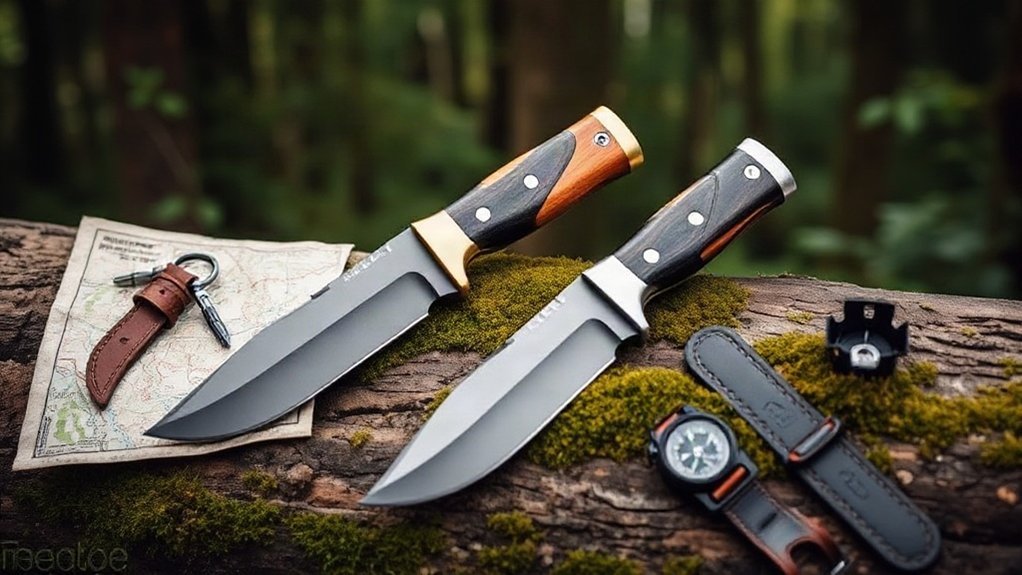
I choose a fixed-blade survival knife by matching its size and construction to my trip’s main tasks, from carving and food prep to splitting kindling. For routine camp work, I look for a 3.5–5-inch blade, a secure grip, and a dependable sheath. I also weigh steel against my upkeep habits: carbon steel sharpens easily but needs drying and oiling, while stainless resists corrosion better. Choose a suitable grind and carry weight, and you’ll find more guidance below.
Key Takeaways
- Match blade length and thickness to your tasks: 3.5–5 inches suits most camp chores, while thicker blades handle heavier splitting.
- Choose a dependable full-tang fixed blade for demanding work; consider a Scandi grind for carving or a full-flat grind for slicing.
- Select steel based on upkeep: carbon steel sharpens easily but needs drying and oiling; stainless resists corrosion but is not rust-proof.
- Check that the handle stays secure in your hand and the sheath retains the knife safely and comfortably.
- Follow the maker’s guidance for batoning, avoid twisting or prying, and consider trip length, weight, budget, and local knife laws.
How Do You Choose a Bushcraft Knife?
How do you choose a bushcraft knife? I start by defining the work I expect it to handle, then weigh cost, upkeep, and local rules. Budget planning helps me avoid paying for features I won’t use; I’d rather invest in dependable construction, a comfortable grip, and a secure sheath. I also check legal restrictions before buying or carrying a knife, since blade laws vary by place.
Steel affects how much care I’m willing to give my tool. I can sharpen 1095 carbon steel easily, but I must dry it and protect it from rust. Stainless Sandvik 12C27 needs less corrosion maintenance. For controlled carving, I favor a Scandi grind because it’s straightforward to sharpen; a full-flat grind suits slicing and food prep. I choose a full-tang fixed blade for demanding woodwork, while a folder can handle lighter chores. When wood gets large or knotty, I reach for a saw or hatchet instead.
Match Knife Size to Your Main Camp Tasks
I choose blade length by matching it to the camp tasks I do most. For carving, food prep, and routine chores, I’d start with a 3.5–5-inch blade; larger wood may call for a longer one. I wouldn’t choose extra reach unless I need it, since a long blade can be harder to control for fine cuts.
Choose Blade Length
When I choose blade length, I match it to the work I do most: a 3.5–5-inch blade suits routine carving, feather sticks, and camp chores, while a shorter blade gives me more control for fine tasks but less reach for batoning. A TOPS BOB Fieldcraft, with its 4.75-inch blade, fits that range. For larger wood and heavier camp work, I might carry an ESEE 6 with a 6.5-inch blade; the Ka-Bar Fighter’s 8-inch blade offers still more reach, but can hinder detailed cuts. The Benchmade Mini Bushcrafter’s 3.38-inch blade gives me precision, though I’d accept its limits when splitting wood. I also check legal restrictions and consider blade geometry: length alone won’t guarantee a capable tool. I’d rather carry a manageable knife that suits my needs than an oversized one.
Prioritize Camp Tasks
Once I’ve settled on a manageable blade length, I match it to my most frequent camp tasks. For carving, feather sticks, food preparation, and routine camp chores, I’d start with a 3.5–5-inch blade. It gives me control without getting in the way, so I can work efficiently and travel light. A thinner blade slices food more easily, while a compact option, such as the 3.38-inch Benchmade Mini Bushcrafter, suits detailed work.
If I regularly split wood or handle larger jobs, I’d consider a 6–7-inch blade, accepting less precision on fine cuts. For light woodworking and meal prep, a folder may be enough; I’d choose a fixed blade when strength matters. If I baton often, I’d favor a sturdy full tang. For large or knotty wood, I’d reach for a saw or hatchet, never twist or pry with my knife.
Why a Fixed Blade Suits Bushcraft Work
For demanding bushcraft work, I prefer a fixed blade because it has no folding joint that could become a weak point during chopping, pounding, or rigorous cutting. That solid construction gives me confidence when I’m working far from camp and need a dependable tool. Fixed blade durability matters when I’m carving, making feather sticks, preparing food, building shelter, or processing firewood. A secure, comfortable grip helps me control each task, while sturdy construction lets me choose a knife suited to the work ahead.
I also look for full tang strength: the blade steel runs through the handle, adding support for heavier jobs such as batoning wood. I wouldn’t use a folding knife for that; its joint isn’t built for repeated impact. A folder can handle lighter carving and food preparation, but a fixed blade gives me greater confidence for demanding chores. With the right fit and construction, I can travel lighter in worry and focus on making camp work on my own terms.
Compare Carbon, Stainless, and Tool Steel
Beyond construction and grip, the steel affects how a knife performs in the field. I’d match it to your trip, maintenance habits, and freedom to travel light.
Match your knife’s steel to the trip, your maintenance habits, and how light you want to travel.
Carbon steels such as 1095, 1075, 5160, O1, and Böhler K720 are tough and offer good sharpening ease, so I can touch them up with simple tools outdoors. They can rust, though. I dry the blade after use and apply light oil; a coating or patina adds some protection.
Stainless options like Sandvik 12C27, M390, N690, and Elmax provide greater corrosion resistance, useful on wet trips or when preparing food. They’re not rust-proof, and some are harder to sharpen or trade toughness for edge retention.
Tool steels, including CPM 3V, CruWear, D2, and Sleipner, sit between the two: they contain more chromium than carbon steel, but aren’t stainless. I also check heat treatment and edge geometry; steel alone won’t determine performance.
Choose a Grind for Carving and Slicing
When I choose a grind, I match it to the work I do most. A Scandi grind gives me control for carving wood, while a flat grind slices food and camp materials more efficiently. I’ll also consider blade thickness, since a thinner blade usually cuts food more easily.
Scandi Grind for Carving
A Scandi grind’s broad, flat bevel makes sharpening straightforward and gives me precise control for carving wood and shaping feather sticks. When I’m off-grid, that reliable edge helps me work confidently with local materials. I use the feather stick technique for fine curls, and I look for an ergonomic carving handle to stay comfortable during longer sessions.
| Knife | Carving advantage |
|---|---|
| Morakniv Kansbol | Scandi grind; thin, profile-ground tip |
| Morakniv Garberg | Full tang; 4.3-inch carbon-steel blade |
| Scandi bevel | Straightforward sharpening |
| Woodworking | Precise control |
| Prolonged carving | Comfortable handle |
The Kansbol’s slim tip also supports woodwork and slicing, while the Garberg suits carving and other fine tasks. I choose this grind when controlled woodworking matters most; it’s less suited than a full-flat grind to general slicing and food preparation.
Flat Grind for Slicing
For slicing and food prep, I favor a full flat grind because it cuts efficiently through camp ingredients and suits general camp work. Its geometry prioritizes slicing performance, so I’d choose it over a Scandi grind when kitchen tasks matter more than controlled wood carving. A slightly thinner blade helps me cut vegetables cleanly, while a thicker one can split wood but may drag through food. I also weigh edge durability against sharpening difficulty, since blade steel and edge geometry affect upkeep as much as grind. The ESEE 6, with 1095 steel, shows that a flat grind can still handle precise woodwork and batoning. I’d match thickness to my plans, then pick the knife that lets me prepare meals and work around camp without carrying a separate blade.
Check the Handle, Spine, and Edge
Choose a knife you can grip securely and control during long carving sessions, especially in wet or cold conditions; textured rubber or polymer can help, while smooth Micarta or G10 may need contours or grip lines. I match the handle grip to my hand and the work I expect to do, because a secure hold matters more than any material label.
I also check the spine before committing. A squared 90-degree edge can strike a ferro rod and scrape materials, but it may compromise spine comfort when I press my thumb against it during extended carving. Jimping can add thumb control; I treat it as a personal preference, not a must-have.
Finally, I consider the edge. I favor a plain edge for precise carving and easier sharpening in the field. Serrations can cut rope and fibrous materials quickly, but they take more effort to sharpen. The right balance lets me travel light and work confidently.
Use Your Bushcraft Knife Safely for Firewood
When I need to split firewood, I use a sturdy, full-tang fixed blade only if the maker’s guidance allows batoning. I set the edge on suitable wood, then strike the spine with a separate wooden baton. Controlled batoning lets me work deliberately without swinging the knife like an axe.
I keep each cut controlled and direct the blade away from my body. I don’t twist, pry, or chop; those moves can damage the edge or make me lose control. For large or knotty pieces, I choose a saw or hatchet instead. A Scandi grind can make careful woodwork easier, while a thicker blade may split better but feel heavier and less precise for fine carving.
Afterward, I inspect the edge, clean the blade, and dry it thoroughly. With carbon steel, including 1095, I apply a light coat of oil to limit rust. This simple blade maintenance helps keep my knife ready for the next task.
Compare Weight, Sheaths, and Knife Prices
After choosing a knife for safe woodwork, I compare its carry weight, sheath, and total package cost. Pack Weight matters on long walks: the Morakniv Kansbol weighs just 3.52 ounces, while the 15-ounce Uncharted Supply Co Empire may feel heavy on a belt. I weigh those ounces against what each package includes.
Sheath Retention deserves equal attention. The TOPS BOB Fieldcraft’s sheath holds tightly and includes a ferro rod. In testing, the Ka-Bar Fighter 1269’s sheath showed inconsistent retention and cheap snaps. The ESEE 6 sheath is another weak point, so I’d consider an aftermarket replacement before relying on it.
Prices range from $ for the Kansbol and Ka-Bar Fighter 1269 to $$ for the ESEE 6 and $$$ for the Benchmade Mini Bushcrafter. I look beyond the sticker price: the Empire includes a sharpener and ferro rod, while the Kansbol’s standard sheath doesn’t include a sharpener. That comparison helps me spend wisely and carry with confidence.
Which Bushcraft Knife Fits Your Trip?
Which bushcraft knife fits your trip depends on the work you expect it to do. For carving, fire-making, and everyday camp chores, I’d start with a 3.5–5-inch blade. The 4.25-inch Morakniv Kansbol weighs just 3.52 ounces, making it a light, budget-friendly choice when I want to keep my pack nimble.
For a compact trip focused on fine woodwork, I’d consider the full-tang Morakniv Garberg Survival. Its 4.3-inch blade and Scandi grind handle detail work well, though limited chopping ability is the trade-off. If heavier wood processing matters, I’d choose a sturdier KA-BAR Becker BK2 or Cold Steel SRK. For large or knotty wood, I’d bring a saw or hatchet.
I’d also weigh seasonal conditions, trip duration, and camp demands. The 6.5-inch ESEE 6 offers reach, but its carbon steel needs drying and oiling. A thinner blade slices and preps food easily; a thicker one tolerates splitting but adds weight and limits fine work.
Frequently Asked Questions
What Is the Best Fixed Blade Knife for Bushcraft?
I’d choose the TOPS BOB Fieldcraft as the best all-around fixed-blade bushcraft knife. Its 4.75-inch, full-tang 154CM blade handles carving and camp chores, while its sheath includes a ferro rod for greater independence outdoors. I value its contoured G10 Handle Ergonomics for a secure grip and practical control. Among Blade Steel Choices, 154CM offers stainless-steel convenience, though you should still maintain the edge. For lighter trips, consider the Morakniv Kansbol.
What Is the Best Knife for Wilderness Survival?
I’d choose a full-tang fixed blade for wilderness survival, but the best knife depends on what you’ll do. For a versatile first pick, I’d look for a 3.5–5-inch blade length that gives you control for carving and camp chores. Match the knife steel to your conditions: stainless steel resists corrosion, while carbon steel needs drying and oiling. If you’ll split wood, follow the maker’s guidance; I’d use a saw or hatchet for large logs.
What Fixed Blade Do Navy SEALS Use?
No single fixed blade is confirmed as standard issue for Navy SEALs. I’d treat claims naming a specific “SEAL knife” cautiously unless a reliable source backs them. Why let a label choose your gear when your mission demands sound judgment? The Cold Steel SRK is popular among military personnel and outdoor enthusiasts, but that doesn’t prove SEALs use it. Its six-inch blade, grippy Kraton handle, and practical build make it one option among military field knives and SEAL knife choices.
What’s the Difference Between a Bushcraft Knife and a Survival Knife?
A bushcraft knife favors controlled outdoor work; a survival knife aims for broader emergency versatility. I’d compare their purpose and design before choosing: bushcraft models often feel lighter and excel at carving, while survival knives may handle batoning, chopping, or prying. Blade thickness and edge geometry also matter: a Scandi grind supports precise carving, while a thicker, tougher blade tolerates harder tasks. The categories overlap, so I’d pick what suits your trip and freedom.
Conclusion
I choose a bushcraft knife by matching its size, steel, grind, grip, and sheath to the work I’ll actually do—not the wilderness heroics I imagine. A fixed blade can handle carving, food prep, and firewood, but it won’t replace judgment or safe technique. I’d rather carry a modest, well-made knife I can maintain than a costly showpiece that needs rescuing. The irony? The best survival knife is the one I rarely have to prove myself with.