What Makes Hatchets and Tomahawks Different in Design and Performance?
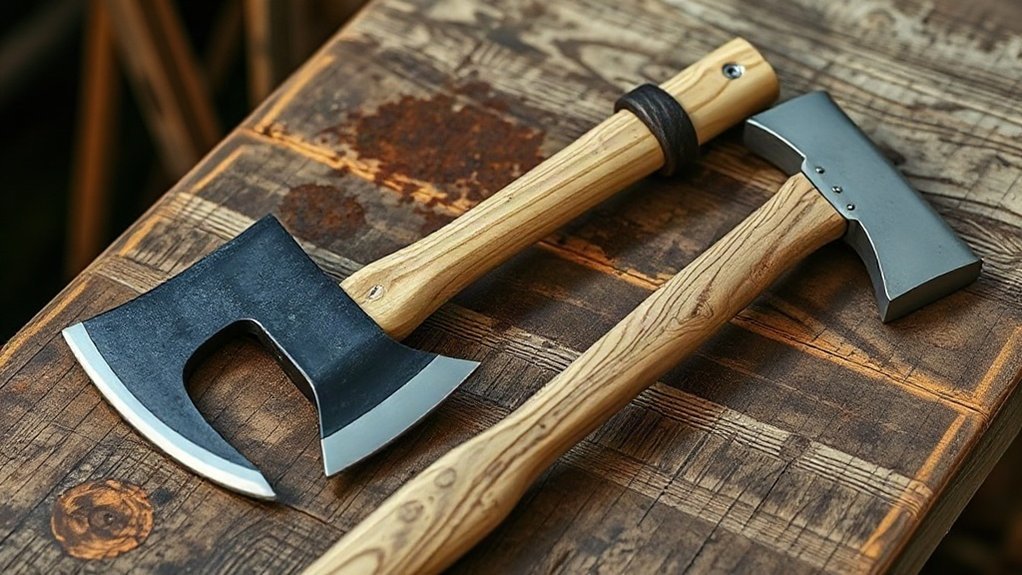
I’d choose a hatchet for powerful, repeated wood chopping and a tomahawk for lighter, more agile utility. Hatchets usually have heavier, thicker heads and shorter handles, giving me more force and control for splitting kindling or processing small firewood. Tomahawks are often lighter, with longer handles and slimmer blades, so I can maneuver them quickly and use them for tasks such as throwing or carving. Their differences in balance, materials, and head design can help you decide which suits your needs.
Key Takeaways
- Hatchets typically have heavier, thicker, wedge-shaped heads for forceful chopping and splitting; tomahawks are lighter and slimmer for agile handling and light cutting.
- Hatchet handles are usually shorter, around 10–16 inches, while tomahawk handles often measure 16–22 inches for extra reach and throwing rotation.
- A hatchet’s head-forward balance builds chopping momentum, while a tomahawk’s lighter, more even balance supports quick movement and controlled rotation.
- Hatchets commonly have a solid blunt poll; tomahawks may have a hammer poll or a spike for driving stakes or puncturing materials.
- Choose a hatchet for regular firewood and kindling work, or a tomahawk for throwing, light chopping, and versatile utility.
What’s the Main Difference Between a Hatchet and a Tomahawk?
A hatchet is a compact wood-chopping tool, while a tomahawk is typically lighter and more agile. The Primary design purpose explains the difference: I’d choose a hatchet for repeated firewood processing, but a tomahawk for lightweight carry and versatile utility. Neither tool locks you into just one task, yet each excels where its balance and intended use align.
Their historical origins also help explain their distinct roles. Hatchets developed as practical tools for chopping and splitting wood. Tomahawks evolved as lighter, adaptable tools, valued for mobility and varied uses. If you want dependable force at camp, a hatchet offers a focused choice. If you prize freedom of movement and flexibility, a tomahawk may suit you better. I’d match the tool to the work, rather than assume one can replace the other.
How Do Their Heads Differ?
I’ll compare head weight and shape: hatchets usually carry thicker, heavier heads, while tomahawks favor lighter, slimmer designs. Their blade edges also differ, affecting chopping durability and quick cuts. I’ll also look at polls, spikes, and eyes, which shape each tool’s uses and attachment to the handle.
Head Weight and Shape
Because head weight and shape affect how each tool performs, the differences are easy to feel. When I pick up a hatchet, its heavier hatchet heads—often around 1.5 to 2 pounds—put more weight behind each swing. Their wedge shaped profiles concentrate that mass for forceful chopping and splitting, so I can work through wood with fewer limits.
A tomahawk head usually weighs closer to one pound. Its lighter, narrower shape lets me make precise cuts with less impact and makes the tool easier to rotate when thrown. I’d choose it for lighter chopping, not repeated splitting. Some models add a spike or hammer poll opposite the blade, while hatchets more often carry a solid, heavier poll. The difference gives me a straightforward choice: power for wood or agility and control.
Blade Thickness and Edge
The blade edge shows the difference in how these heads handle wood. I find a hatchet’s thicker, wedge-shaped blade better suited to driving into wood and splitting it with repeated blows. Its substantial build can withstand hard impacts, and its bevel geometry supports tough, forceful work. That design offers dependable edge retention when you need to process wood without treating each strike like a delicate cut.
A tomahawk usually carries a thinner, lighter head with a narrow edge. I can make quick cuts with it, and its lighter build rotates more easily when thrown. But that edge may chip if I use it for repeated, heavy splitting. Choose according to the freedom you want in the task: a hatchet favors durable splitting, while a tomahawk favors agility and quick cuts.
Polls, Spikes, and Eyes
Beyond blade thickness, the poll, spike, and eye shape also set these tools apart. I look at the poll face uses to understand each head’s purpose: a hatchet’s solid, blunt poll can support chopping and, on some models, hammering. A tomahawk may trade that face for a narrow spike, concentrating force for puncturing or breaching—not splitting wood.
| Head feature | What you gain |
|---|---|
| Hatchet poll | A steady hammering option |
| Tomahawk spike | Focused breaching force |
| Hatchet head | Weight for repeated chops |
| Tomahawk eye | Freedom to remove the head |
The eye taper function matters: many traditional tomahawks have tapered eyes, so you can remove the head; most modern hatchets lock it firmly in place. A lighter tomahawk often feels agile, while a heavier hatchet favors sustained chopping.
How Does Handle Length Affect Control?
I find a short handle easier to guide for precise chopping and camp chores. A longer handle gives a tomahawk room to rotate smoothly when thrown, but it can feel awkward in close woodwork. I’ll help you match handle length to the task and find a balance of reach and control.
Short Handles, Precise Control
Because a shorter handle keeps the head close to your hand, a hatchet’s typical 10–16-inch length makes it easier to guide precise cuts when chopping kindling or trimming branches in tight spaces. I value that compact control when camp tasks demand accuracy and freedom to work in confined spots.
| Task | Handle advantage | Control focus |
|---|---|---|
| Kindling | Close guidance | Short strokes |
| Branch trimming | Compact reach | Wrist positioning |
| Repeated chopping | Steady leverage | Grip adjustment |
A short-to-mid-length handle helps me keep each chop controlled without feeling clumsy. I can adjust my grip and wrist positioning to suit the cut, while keeping the head’s path deliberate. Tomahawks commonly use 16–22-inch handles, which can feel less compact for detailed woodwork. I choose a hatchet when controlled chopping matters most; handle length should match the task, not limit my movement.
Long Handles, Smooth Rotation
When a tomahawk’s handle reaches about 16–22 inches, it gives the head room to rotate smoothly during a throw. I find that extra handle clearance helps the tool complete its throwing rotation without interference, supporting a clean, predictable release. The added length can also build swing speed, giving you room to develop your own rhythm outdoors. But longer doesn’t always mean easier: I need more space and careful control to manage a full swing. A handle that’s too short may disrupt rotation, while one that feels unwieldy can compromise precision. Hatchets, with handles commonly around 10–16 inches, offer closer control for chopping and repeated woodwork. For varied outdoor use, I’d consider a mid-length handle when I want throwing ease without giving up practical chopping control.
Match Length to Task
Choose handle length by the work you expect to do. I favor a compact hatchet, usually 10–16 inches, when I’m chopping branches, kindling, or firewood. Its shorter grip gives me control in tight spaces. A tomahawk’s 16–22-inch handle adds Handle reach and swing comfort for throwing, with more room to build speed and rotation.
| Task | Handle length | Feel |
|---|---|---|
| Kindling | 10–16 in. | Nimble, controlled |
| General use | Mid-length | Balanced, versatile |
| Throwing | 16–22 in. | Longer swing, rotation |
If a tomahawk’s handle is too short, it may rotate poorly in flight; too long, and it can feel clumsy for chopping. For freedom to tackle varied outdoor jobs, I’d choose a mid-length option. When possible, hold the tool first and check that its reach and balance suit you.
How Does Balance Change Chopping and Throwing?
Balance changes how each tool moves: a hatchet’s head-forward weight builds momentum for forceful chopping and splitting, while a lighter, more evenly balanced tomahawk feels quicker and easier to control. I choose based on the movement I need, not one tool’s supposed superiority:
Balance shapes each strike: a head-heavy hatchet drives force, while a lighter tomahawk offers quicker, more controlled movement.
- For chopping, concentrated head weight helps drive a hatchet through wood, though repeated swings can increase Swing Fatigue.
- For quick handling, a tomahawk’s lighter, more neutral balance feels responsive and gives me greater control.
- For throwing, even weight distribution supports Rotation Consistency, helping the tomahawk turn predictably toward its target.
- A heavy, head-forward hatchet may rotate poorly in flight; I don’t assume its chopping power makes it a reliable throwing tool.
Matching balance to the task lets me choose freely and work with confidence.
Which Tool Is Better for Camp Chores?
For camp chores, I reach for a hatchet if I’m preparing firewood regularly: its heavier, wedge-shaped head chops branches and splits kindling more efficiently. For Firewood processing and Kindling preparation, that extra force saves effort when I’m working through a small pile. I’d choose a handle around 14–16 inches and a head weighing about 1.5–2 pounds for a useful balance of control and power. A hatchet can also help me limb branches or drive tent stakes, depending on its design.
A tomahawk can manage light chopping and utility work, but its thinner, lighter head isn’t as efficient for repeated chopping or splitting. If I value mobility and expect only occasional light tasks, I might carry one instead. I choose the tool that fits my chores, so I can work independently without carrying more than I need.
What Can a Tomahawk Do Besides Chop?
A tomahawk can do more than chop: I can use its light, agile design for target throwing, though reliable accuracy takes practice. Beyond that challenge, I value its versatility when I want a compact tool for varied tasks. Its thin blade offers control for precise work, while some models add a spike or hammer poll. Depending on the design, I can use it to:
> A tomahawk’s light, adaptable design suits precise tasks and throwing, though practice is needed for accuracy.
- Trim small branches or carve with the blade’s fine edge.
- Drive stakes with a hammer poll, supporting a simple camp setup.
- Puncture tough material using a spike-equipped head.
- Pry or hook objects, or cut cordage with suitable tactical models.
These options give me flexibility without tying me to one task. Still, I won’t expect a tomahawk to match a heavier hatchet for repeated chopping or splitting firewood.
Which Tool Is Better for Woodwork?
When I’m doing regular woodwork—chopping branches, limbing, or preparing firewood—I reach for a hatchet. Its heavier, wedge-shaped head delivers more force, so I can work efficiently and stay in control. A 1.5–2-pound head on a 14–16-inch handle gives me a practical balance of power and maneuverability.
For repeated chopping and splitting kindling, the hatchet’s design makes the job easier. I pay attention to the wood grain and adjust my splitting technique to guide each strike. A tomahawk can manage light chopping or carving, but its lighter, thinner head is less efficient for splitting and may not hold up as well to repeated heavy impacts.
If I value low weight and versatility, I’ll choose a tomahawk. For dependable camp chores, I prefer a hatchet.
How Do Steel and Handle Materials Affect Performance?
Steel and handle materials shape how each tool cuts, feels, and holds up over time. When I compare them, I look beyond the edge: steel toughness, impact resistance, grip, and repairability all matter. These details let you work with confidence and maintain your own gear.
- High-carbon steel holds a sharp edge, but hardness and heat treatment determine whether it chips under impact.
- A hatchet’s thicker blade and heavier head drive chopping force; a thinner tomahawk edge cuts lightly but may chip during repeated splitting.
- Wood absorbs some shock and can be replaced. Fiberglass and steel handles resist weather and breakage, though they may transmit more vibration. Handle durability depends on both material and use.
- A short, sturdy hatchet handle supports control; a longer tomahawk handle adds swing speed. Removable tomahawk heads simplify repairs, while hatchet heads are usually fixed.
How Do You Choose the Right Tool?
Choose the tool by matching it to your main task: I’d pick a hatchet for frequent kindling, branch cutting, and firewood, while a tomahawk suits throwing, light chopping, and versatile utility work. A 14–16-inch hatchet with a 1.5–2-pound head balances control and chopping power. Tomahawks often have lighter heads and 16–22-inch handles for quicker, controlled rotation, but their thinner edges aren’t ideal for repeated splitting.
Before buying, consider weight, balance, handle material, and steel quality. If possible, hold each tool and check its comfort for the work you’ll do. Set a Purchase budget that reflects quality and intended use, and include safety training if you’ll throw or chop. If your needs span regular wood processing and utility tasks, carrying both gives you freedom to choose the right tool without compromise.
Frequently Asked Questions
What Are the Key Differences Between a Hatchet and a Tomahawk?
I’d choose a hatchet for chopping and splitting, while I’d pick a tomahawk for lighter, more agile tasks. A hatchet’s thick, wedge-shaped Head shape bites into wood, and its sturdy, 10–16-inch Handle design gives me control for repeated swings. A tomahawk usually has a thinner head and a 16–22-inch handle, so I can carry or throw it more easily. Some tomahawks also offer removable heads or a hammer or spike.
Why Do Navy Seals Use Tomahawks?
I see a tomahawk as a compact key that can open options when obstacles block the way. Some Navy SEALs use one for breaching applications, cutting, prying, or delivering blunt impacts; its light head and longer handle support quick, controlled swings in tight spaces. I value its field versatility, but it isn’t standard gear for every SEAL or ideal for heavy wood chopping. It’s a specialized tool, not a universal solution.
Can a Tomahawk Be Used as a Hatchet?
Yes, you can use a tomahawk as a hatchet for light chores like cutting kindling, trimming small branches, and occasional chopping. Its Tomahawk chopping performance usually falls short when splitting dense wood because its lighter, thinner head lacks a hatchet’s wedge-shaped heft. I’d choose freely based on your needs: a tomahawk offers versatility, while a hatchet handles regular firewood work better. Consider tomahawk handle ergonomics, too; its longer handle may feel less controlled up close.
What Are the Key Differences Between an Axe and a Hatchet?
An axe is larger and usually needs two hands; a hatchet is compact and works one-handed. You might think size alone decides the job, but control matters just as much. I’d compare Axe Handle Length and head weight: a hatchet’s 10–16-inch handle and 1–2-pound head suit kindling and small branches, while an axe gives you reach and leverage for bigger logs. Cutting Edge Geometry shapes how each bites, splits, and steers through wood.
Conclusion
I choose a hatchet when I need a compact tool for camp chores, such as splitting kindling or trimming branches. A tomahawk makes more sense when I value a longer handle, a versatile head, or throwing practice. For example, on a weekend camping trip, I’d pack a hatchet for preparing firewood but choose a tomahawk for lighter tasks and extra versatility. Before buying, I’d consider the work I actually do, then compare head shape, balance, handle, and steel.