Which Bushcraft Knives Are Best for Batoning and Splitting Wood?
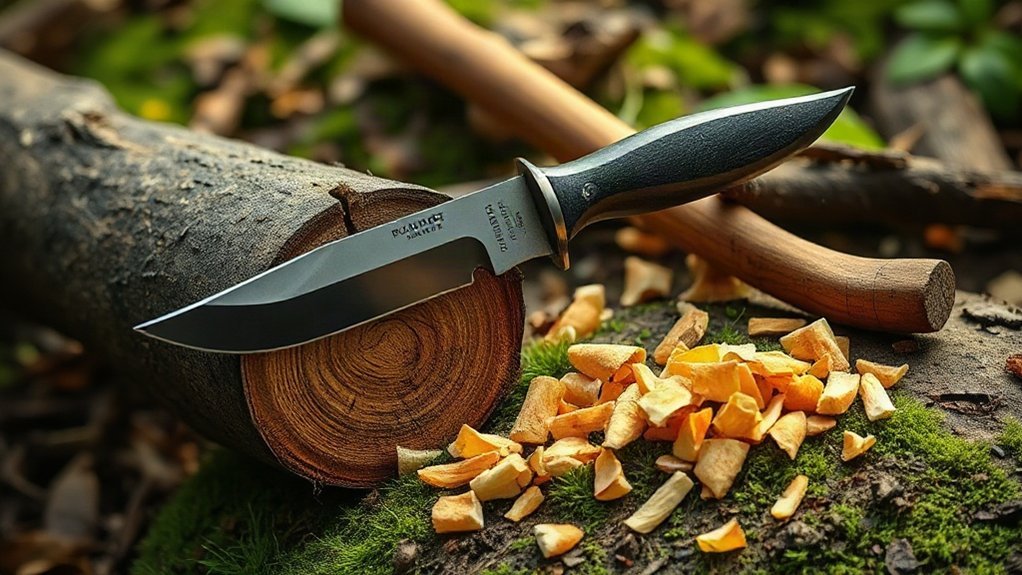
I recommend a sturdy, full-tang fixed blade with a thick spine for batoning and splitting small logs. The Ka-Bar Becker BK2 is a strong choice, with a 5-inch, quarter-inch-thick blade built to take repeated impacts. The Condor Hudson Bay also handles demanding firewood tasks, while the lighter ESEE 6 offers better slicing and versatile handling. Save large or knotty logs for an axe or hatchet, and I’ll explain how blade design, safe technique, and comfort shape the best choice.
Key Takeaways
- Choose a sturdy, full-tang fixed blade with a thick spine; the Ka-Bar Becker BK2’s 5-inch, 6 mm blade suits batoning.
- The BK2’s weight helps split manageable firewood, while the Condor Hudson Bay handles demanding camp tasks and wood processing.
- The ESEE 6 is lighter and slices well, but is less suited to heavy chopping than the BK2 or a kukri.
- Prefer a blade at least 4.5–5 inches long; thicker blades split effectively but weigh more and slice less efficiently.
- Baton only small, knot-free logs with a wooden baton; use an axe or hatchet for large or knotty wood.
Which Bushcraft Knives Handle Batoning Best?
When I baton wood, I favor a sturdy full-tang fixed blade with a thick spine, such as the Ka-Bar Becker BK2, whose 5-inch blade is ¼ inch thick. Its robust build gives me confidence when I drive a wooden baton through manageable firewood. Spine thickness matters because a stout blade can take repeated impacts better than a thin, delicate one. I also check tang construction: a full tang extends through the handle, providing dependable support under force.
For a longer option, I’d consider the ESEE 6. Its 6.5-inch, roughly 5/32-inch-thick 1095 blade has a full flat grind, keeping it relatively light while still capable of splitting wood. The Condor Hudson Bay offers an 8.5-inch, 3/16-inch-thick 1095 blade for demanding camp chores, including firewood processing. I choose the knife that suits the wood and the work, then baton carefully. For large or knotty logs, I reach for an axe or hatchet instead.
How Do the Four Knives Compare?
How do these four knives compare for wood processing? I’d choose the Gurkha kukri when heavy chopping matters most. Its forward-shifted weight delivers powerful swings, making it the strongest chopper here. For splitting, the compact Ka-Bar Becker BK2 drives through wood with its substantial heft, while the Condor Hudson Bay also handles demanding camp tasks and firewood processing. The ESEE 6 feels lighter and slices well, but it can’t match the heavier knives for chopping and feels less handy for fine carving.
All four can baton or chop, so your choice comes down to how you work. The kukri favors chopping; the BK2 and Hudson Bay bring useful splitting heft; the ESEE 6 offers freer, more versatile handling. I’d weigh comfort, weight balance, and handle durability against the demands of your camp routine. The Hudson Bay’s carbon steel needs care to prevent rust, so consider whether you’ll maintain it. Choose the tool that fits your priorities, not a one-size-fits-all ideal.
How Do Blade Length, Steel, and Grind Matter?
For batoning, I look for a fixed blade at least 4.5–5 inches long and 3 mm thick. That size gives you enough blade reach to split substantial pieces while keeping the knife manageable. The BK2, with its 5-inch, 6 mm blade, and the ESEE 6, with its 6.5-inch, roughly 4 mm blade, show how sturdy options vary. Longer blades reach deeper into larger wood; shorter ones offer more control. For big or knotty logs, I switch to a saw or hatchet.
Steel affects steel maintenance and sharpening. I can sharpen 1095 easily, but I need to dry and oil it to prevent corrosion. Stainless CPM-S30V resists rust and holds an edge well, though sharpening takes more effort. A thick blade wedges wood apart, but adds carry weight and slices less efficiently. I favor a convex edge for batoning; a saber grind helps split, while a flat grind trims weight without losing useful heft.
Which Bushcraft Knives Suit Chopping or Carving?
Blade length and grind matter, but a knife’s balance and grip also determine whether it chops cleanly or feels controllable while carving. For Kukri chopping performance, I’d choose the Nepalese kukri: its 10-inch, 10 mm-thick curved blade concentrates weight near the tip, helping cut hazel and willow. For finer work, I’d favor a shorter, comfortable knife that lets you guide each pass.
| Knife | Best suited to | Trade-off |
|---|---|---|
| Nepalese kukri | Chopping coppice | Front-heavy for carving |
| Ka-Bar Becker BK2 | Robust camp chores | Heavy for fine detail |
The BK2’s compact five-inch, 6 mm blade handles tough tasks, but its weight limits knife carving control. The ESEE 6 slices well and serves camp kitchens, though its 6.5-inch length can hinder detailed cuts. The 8.5-inch Condor Hudson Bay tackles shelter work and firewood processing; protect its 1095 steel from rust. For regular carving, I’d start around 3.5–5 inches, prioritizing a controllable edge and secure, comfortable grip over maximum size. That balance keeps your choices flexible in camp.
How Can You Baton Safely: and When Should You Use an Axe?
When I baton wood, I set a small log upright on solid ground, choose a clear spot, and keep my hands and body out of the striking path. That stable wood setup gives me control, while a safe striking zone keeps my movements clear of anyone nearby.
I align a sharp, straight knife with the grain, then use a wooden baton to strike the spine squarely. I work the blade through the wood without twisting or prying, which can damage the edge or break the knife. I start with small logs and check for knots, nails, stones, or other obstructions before striking.
Batoning suits kindling and small carving pieces, not large logs or cords of wood. It puts stress on a knife, so I switch to an axe or hatchet when the wood gets bigger or knotty. Its heavier head and longer handle give me more leverage for sustained splitting, letting me work efficiently and choose the right tool for the job.
Frequently Asked Questions
What Are the Best Knives for Splitting Wood?
For splitting wood, I’d choose the Ka-Bar Becker BK2 for its stout, quarter-inch-thick, full-tang blade, or the Condor Hudson Bay for its longer reach and demanding camp work. A kukri’s forward-weighted blade excels at chopping. I’d check Knife blade thickness and strike with a wooden baton, aligning the edge with the wood grain direction. For large or knotty logs, I’d switch to an axe or hatchet for safer, freer work.
What Is the Best Bushcraft Knife of All Time?
I’d crown the TOPS BOB Fieldcraft the best bushcraft knife of all time for its versatility, not because any blade suits everyone. Unlike historic knife designs or survival knife legends, it balances carving, camp chores, fire-starting, and splitting with a 4.75-inch 154CM blade and grippy G10 handle. You’re free to choose differently: pick the Morakniv Kansbol for light carry or the Becker BK2 when heavy batoning matters most.
What Is the Holy Trinity of Knives?
The bushcraft “holy trinity” is a large knife, a small knife, and a saw or hatchet. I’d choose this three knife system—though one tool is usually a saw or axe—to cover heavy wood processing, fine carving, and efficient cutting. You can adapt the set to your tasks and pack limits. I value blade role balance: a big knife handles modest batoning, while a saw or hatchet tackles larger, knotty wood with less effort.
What Is a Baton Knife?
A baton knife is a sturdy fixed-blade knife you use to split small wood by striking its spine with a wooden baton. I look for solid baton knife construction: a full tang and a blade around 3 mm thick, while checking the maker’s guidance. For baton knife safety, I avoid folders, keep hands clear, and use controlled strikes. It’s a useful camp tool for kindling, not a substitute for an axe.
Conclusion
I’d choose a full-tang bushcraft knife with a sturdy spine, durable steel, and a blade long enough to split the wood I actually carry. Among the four, the best fit depends on whether I value batoning, chopping, or fine carving most. I baton carefully, keep my hands clear, and reach for an axe when the rounds get stubborn. Choose for your tasks, not hype—and let your knife earn its place in your pack, good sir knight.