Are Sleeping Pads Thick Enough for Side Sleepers and Heavier Campers?

I recommend at least a 3-inch sleeping pad for most side sleepers; thinner pads can let hips and shoulders bottom out, especially on firm ground. If you’re heavier or have sensitive pressure points, I’d look for a supportive 3.5- to 4-inch model. Thickness isn’t everything, though: firmness, baffle design, and compression affect support. Choose a width that keeps your knees and elbows on the pad, then adjust inflation until your body feels supported. A few checks can help you find the right setup.
Key Takeaways
- Side sleepers should generally choose pads at least 3 inches thick to reduce the risk of hips and shoulders bottoming out.
- Heavier campers or those with sensitive pressure points may benefit from 3.5–4-inch pads, though thickness alone doesn’t guarantee support.
- Check support by lying on your side: hips and shoulders should stay off the ground, with the waist comfortably supported.
- Adjust inflation until the pad feels supportive without being rigid; choose a thicker or more supportive model if you still bottom out.
- Pads under 2.5 inches may work on soft ground or cushioned surfaces, but can be uncomfortable on rough terrain or longer trips.
Are Sleeping Pads Thick Enough for Side Sleepers?

Are sleeping pads thick enough for side sleepers? Usually, yes—if the pad keeps your shoulder and hip from pressing into the ground. I judge pad thickness by how it performs under my weight, not just by its listed inflated height. Baffle design and inflation level also shape the support, so two sleeping pads with the same measurements can feel different.
To check the fit, I lie on my side with my knees slightly bent. My shoulder and hip should feel cushioned, while my waist stays comfortably supported. I inflate the pad fully, then release air in short bursts until my body settles without bottoming out. If I feel the ground, I add air.
A wider pad can make camp sleep less restrictive: 25 inches gives bent knees and elbows more room to move. I also check the R-value for warmth, but it doesn’t determine whether a pad suits a side sleeper. Inflatable pads offer more packed space savings than foam mats while providing substantial insulation per inch. I can adjust the setup to match my comfort outdoors.
How Thick Should a Sleeping Pad Be?
I recommend at least 3 inches (7.6 cm) for side sleeping. For more cushioning under your hips and shoulders, I’d look for 3.5–4 inches (8.9–10 cm). Check the fit by lying on your side: your hip and shoulder should sink in without touching the ground. Thickness adds cushioning, but a pad’s R-value is what indicates its insulation.
Minimum Practical Thickness
For side sleeping, I’d treat about 3 inches (7.6 cm) as the practical minimum; thinner pads are more likely to let your hips or shoulders press into firm or uneven ground. Below 2.5 inches, I’d be especially cautious if you sleep on rough terrain or carry more weight. A foam pad and an air pad can feel different at the same thickness, since construction and firmness affect how well each supports you. Remember, the listed thickness measures the pad’s height when inflated—not the support you’ll get under your body. If your hips or shoulders touch the ground, add air or choose a thicker, more supportive model. I’d also weigh extra cushioning against stability: a very tall pad may shift as you roll, making it harder to rest comfortably.
Ideal Thickness Range
A 3.5–4-inch pad is a good target for most side sleepers, giving your hips and shoulders extra cushioning and room to adjust firmness without bottoming out. I’d choose within this range for a comfortable night without carrying more bulk than I need.
- For heavier campers or sensitive pressure points, I’d aim near 4 inches, but I’d check support, not just the sleeping pad’s listed thickness.
- If I’m lighter or sleeping on softer ground, 2–2.5 inches may work, though I’d expect a comfort compromise on longer trips.
- I’d balance cushioning with stability: pads thicker than 4 inches can feel less steady when I roll over.
Thickness isn’t insulation, so I’d also check the pad’s warmth rating for the conditions. That way, I can stay comfortable and move freely without choosing extra height by default.
Do Heavier Campers Need a Thicker Pad?
If you carry more weight, your hips and shoulders can compress a pad enough to bottom out. I’d start with at least 3 inches, though 3.5–4 inches gives you more room to adjust firmness. Thickness isn’t everything: I’d also check the baffle design and how well the pad supports you when you lie on your side. If you stack pads, their R-values add up, which can increase insulation from cold ground.
Weight And Compression
Because heavier campers put more pressure on their hips and shoulders, a pad that supports a lighter sleeper may compress until they feel the ground. When I choose a sleeping pad for backpacking, I treat thickness as a starting point, not a guarantee against the cold ground. Two pads with the same listed height can compress differently because their construction distributes weight differently.
- I look for about 3 inches as a practical minimum; 3.5–4 inches gives more cushioning and room to adjust firmness.
- I inflate the pad, lie on my side, and add air if my hip reaches the ground.
- If it feels too firm, I release air gradually. A 4-inch pad may let me sleep softer without bottoming out.
I still weigh comfort against carrying a lightweight setup.
Support Beyond Thickness
Although a thicker pad can help, I don’t judge support by height alone: internal construction and firmness also determine whether your hips and shoulders stay off the ground. For many side sleepers, I consider 3 inches a practical minimum; 3.5 to 4 inches gives you more cushioning and room to adjust. A self-inflating pad, air mattress, or camping cot can feel different, so don’t choose by r-value or height alone. I inflate the pad fully, lie on my side, then release air gradually until my shoulder and hip settle comfortably without my hip touching the ground. If you feel the ground or your hips sink too far, add air. Too much firmness can stop your body settling. If adjustment doesn’t solve bottoming out or discomfort, choose a thicker or more supportive model.
How Wide Should a Sleeping Pad Be?
How wide should your sleeping pad be? I’d start with a 25-inch model if you sleep on your side. That extra room over a standard 20-inch pad gives your bent knees and elbows space to stay supported. If you roll often or move around, consider 30 inches—but only after checking that it fits your tent.
- Match the shape to your sleep. A rectangular pad usually offers more usable space than a mummy shape, whose tapered sides can limit movement.
- Measure your shelter. Check the tent floor’s interior width, then account for another sleeper and any gear you’ll keep inside. A wide pad won’t help if it crowds your setup.
- Choose width for freedom, not as a fix for everything. More room can keep your knees and elbows from slipping onto the ground, but it won’t replace adequate thickness or hip support.
Tent capacities can be optimistic estimates, so leave room for your pad, a tentmate, and gear.
I’d make pad dimensions part of campsite selection, especially when sharing a compact tent.
Which Pad Baffles Feel Best for Side Sleepers?
Baffle design can change how well a pad supports your hips and shoulders. I look for a broad, even surface that cushions pressure points without ridges. Horizontal flat-top baffles, like those on Exped Ultra pads, spread weight evenly. NEMO Tensor’s Spaceframe baffles and internal trusses also create flat support.
| Baffle style | Feel for side sleepers |
|---|---|
| Flat-top or Spaceframe | Even, supportive |
| Air Sprung Cells | Contouring, mattress-like |
| Triangular Core Matrix | Light and warm; ridges may press |
| Offset I-beams | Soft, quilted; less stable |
Sea to Summit’s interconnected Air Sprung Cells contour around hips and shoulders, which I’d choose for a more mattress-like feel. Therm-a-Rest’s Triangular Core Matrix saves pack weight and stays warm for cold-weather trips, but its ridges may bother sensitive pressure points. Big Agnes Rapide SL feels soft and blanket-like; restless sleepers may find it less stable. For hammock camping, a diagonal lay can help side sleepers find a more comfortable position. I’d compare these designs in person when possible, then pick a durable pad that suits your sleep style and freedom to roam.
How Firm Should You Inflate a Sleeping Pad?
For side sleeping, I inflate the pad fully, lie down with my knees slightly bent, then release air in short bursts until my hip and shoulder feel supported and my waist stays level. Side sleepers need a slightly soft feel, not a firm, rigid surface or a pad that bottoms out. I use this three-point check:
Inflate fully, then release air gradually until your hip and shoulder feel supported and your waist stays level.
- Slide a flat hand beneath your hip. If you feel the ground, add air through the inflation valve.
- Notice your alignment. If your hips sink too far or your spine feels crooked, add air or choose a thicker pad.
- Check both sides, making small adjustments until your hip and shoulder stay supported without touching the ground.
I stop as soon as the sleeping pad feels supportive; excess firmness can create pressure points. Set firmness before bed, then recheck if needed. During winter camping, cooler air can lower pressure overnight, especially after inflation by warm breath. Adjust freely for comfort. A thin foam mat underneath can also add cushioning and help keep your pad from sliding.
When Can a Thinner Sleeping Pad Still Work?
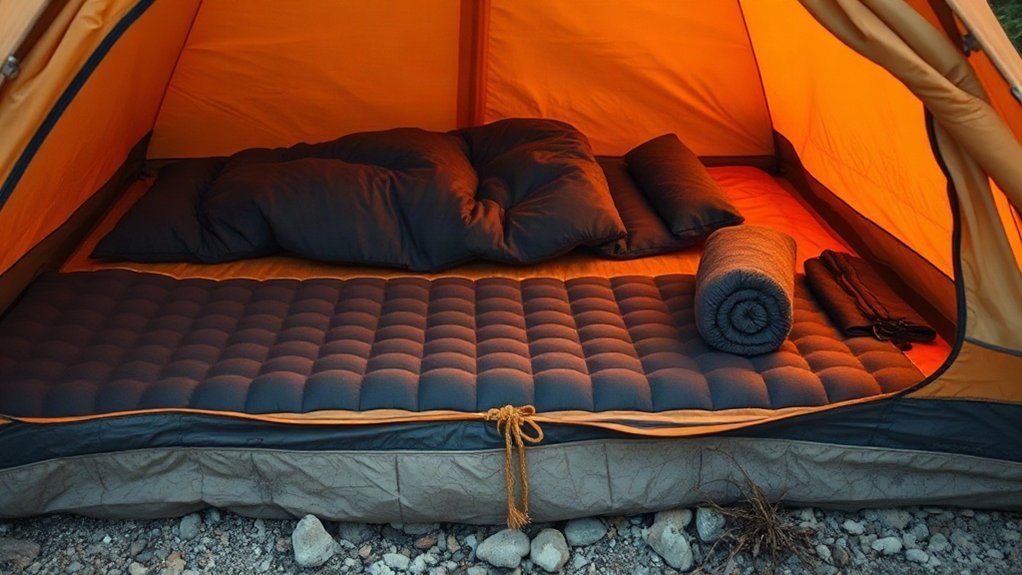
A thinner sleeping pad can still work if you’re lighter, sleeping on a soft surface, or using a cot or vehicle mattress that already cushions you. For a lighter side sleeper, a 2–2.5-inch pad may feel adequate on forgiving ground, but I wouldn’t count on it over firm, rocky, or uneven terrain. Around 3 inches is a practical minimum for side sleeping; some pads at that thickness support you well when properly inflated.
Test the setup before you head out. Lie on your side and let your shoulder and hip settle. If your hip reaches the ground, add air or choose a thicker pad. On a cot or vehicle mattress, a thinner pad can add comfort without unnecessary bulk. Your sleeping bag or camp quilt won’t replace cushioning, and a ground sheet mainly protects your gear. On frozen ground or snow, I’d place closed-cell foam beneath the inflatable pad for added insulation and a more dependable night’s rest. Foam mats are heavier than inflatable pads, but their near-indestructibility can make them a dependable option.
What R-Value Do Side Sleepers Need?
R-value measures insulation from the ground, not cushioning, so it won’t tell you whether a pad will support your hips and shoulders. I match insulation to ground temperature and the rest of my sleep system; pressure points compress bag insulation, so a warmer pad can help limit heat loss.
R-value measures ground insulation, not cushioning; choose a pad that keeps you warm and supports your pressure points.
- For three-season trips, I aim for at least R-3. R-4 to R-5 gives me more margin when shoulder-season nights turn cold.
- For winter or alpine trips, I choose R-6 or higher, especially on frozen ground. I put a closed-cell foam mat beneath an inflatable pad for extra insulation and puncture protection.
- I use ASTM F3340 ratings to compare tested R-values, then consider conditions, not just the season label. A tent footprint won’t add meaningful insulation, and condensation can make camp feel colder, so I keep my sleep system suited to the forecast. For lighter travel, I seek a packable pad that still meets my warmth needs.
What Should You Check Before Choosing a Pad?
Before buying, I check thickness, width, fit, firmness, and insulation. I look for about 3 inches as a practical minimum; 3.5–4 inches gives me more cushioning and room to adjust without my hips touching the ground. I lie on my side with my knees bent and make sure my shoulder and hip stay supported. If I feel the ground, I add air or choose a thicker pad.
I also check whether a 25-inch width fits my tent; it gives bent knees and elbows more room than a common 20-inch pad. To test firmness, I inflate the pad fully, then release air in short bursts until my shoulder and hip settle while my waist stays supported. I match R-value to the trip: roughly R-3 or higher for three seasons, R-4–5 for shoulder seasons, and R-6 or higher for winter. Before leaving base camp, I pack a puncture repair kit for gear repair. A pad coupler can join two pads when I want shared sleeping space.
Frequently Asked Questions
How Thick Should a Sleeping Pad Be for Side Sleepers?
I recommend at least 3 inches (7.6 cm) of sleeping-pad thickness for side sleeping. That gives your hips and shoulders a better chance of staying off the ground. For more cushioning and flexibility, I’d choose a 3.5–4-inch pad, especially on uneven terrain. Don’t rely on listed thickness alone: lie on your side and adjust inflation until you feel comfortable without bottoming out. A pad around 25 inches wide gives you room to move.
Is a Thicker Sleeping Pad Better?
A thicker sleeping pad can feel better, but it isn’t always better. I’d look for about 3 inches as a practical minimum for side sleeping; 3.5–4 inches gives you more cushioning and room to adjust firmness. Still, thickness alone won’t prevent bottoming out—support and inflation matter. I’d inflate the pad, then release air gradually until your hip and shoulder feel comfortable without touching the ground. Above 4 inches, check for wobble when you roll.
Which Camp Pad Is Best for Side Sleepers?
For side sleepers, I’d choose the Sea to Summit Ether Light XR: its 3.9-inch thickness and Air Sprung Cells cushion hips and shoulders while you shift. If you want a versatile, warmer option, I’d consider the 3.5-inch Exped Ultra 6.5R, with an R-value of 6.9 and supportive flat-top baffles. I’d inflate either pad, lie on my side, and adjust firmness until my pressure points feel comfortable without touching the ground.
What to Use Instead of a Sleeping Pad for Camping?
Instead of a sleeping pad, I’d use a camping cot, a foam-integrated mattress, or an air bed, depending on your trip. A cot’s raised, tensioned surface can reduce your need for cushioning, though pressure points may still form. For car camping, I’d choose a 4-inch MegaMat or Nemo Roamer for a bed-like feel. An air bed offers another option, while closed-cell foam works in mild conditions but feels firm.
Conclusion
I choose a sleeping pad by testing comfort, not chasing thickness alone. As a side sleeper or heavier camper, I look for enough cushioning to keep my hips and shoulders off the ground, a width that lets me move, and an R-value suited to the coldest nights I expect. I also adjust inflation until the pad supports me without feeling rigid. The right fit matters more than the biggest specs—measure twice, sleep well once.
References
“Sleeping Pads,” https://www.rei.com/learn/expert-advice/sleeping-pads.html
“Sleeping Pad R-Value: What It Is and Why It Matters,” https://www.thermarest.com/blog/what-is-r-value/
“Sleeping Pads,” https://www.nps.gov/articles/000/sleeping-pads.htm