How Do Sleeping Pads Compare to Air Mattresses for Camping?

I’d choose a sleeping pad for backpacking, walk-in camps, and colder nights: it’s lighter to carry, and an insulated model offers better protection from cold ground. I’d pick an air mattress for car camping when extra height and cushioning matter, provided I have space for its pump and bulkier pack size. Either can work for a mild summer night, but comfort and warmth depend on the sleeper and conditions. I’ll compare the key trade-offs below.
Key Takeaways
- Sleeping pads are lighter and more compact, making them better for backpacking and walk-in camps; air mattresses suit car camping.
- Air mattresses are usually thicker and more bed-like, while sleeping pads offer less cushioning and sit closer to the ground.
- For cool or damp conditions, choose an insulated pad rated R-3 or higher; many typical air mattresses provide less insulation.
- Side sleepers may prefer an inflatable pad at least 8 cm thick or a cushioned air mattress; check support and firmness.
- Pads often inflate quickly with a pump sack, while air mattresses may need a separate pump; protect either inflatable option from punctures.
Sleeping Pad or Air Mattress: The Quick Answer

Choose a sleeping pad for cooler weather, longer trips, or when you need to save space and weight; insulated models also do a better job blocking cold ground. I’d pick one when you want to move freely without hauling bulky bedding. Typical inflatable sleeping pads weigh about 0.3–0.8 kg and pack to roughly 25 × 10 cm, making them easier to carry than most air mattresses.
For cool, damp conditions, check the r-value: I recommend 3 or higher for better insulation. Many air mattresses rate only 1–2, so they can feel cold against the ground. An air mattress makes sense when a thicker, more bed-like surface matters and you have room for the mattress and pump. Expect about 2–4 kg, plus the pump, and a packed size near 40 × 25 cm. For a mild weekend at a drive-in campsite, either option can work; weigh comfort, insulation, setup, and packing space. For side sleepers, an inflatable pad’s pressure-spreading thickness can help keep hips and shoulders off the ground.
Which Option Suits Your Camping Trip?
Which option suits your trip depends on its length, weather, and how you’ll reach camp. I match my sleep setup to the route, forecast, and comfort I want, then let campsite selection guide the final choice.
| Trip conditions | Better fit | Why |
|---|---|---|
| One or two mild nights, car camping | Either | Choose your preferred thickness and comfort. |
| Three or more nights | Sleeping pad | It sets up quickly, insulates better, and is less likely to soften overnight. |
| Walk-in or wild camping | Sleeping pad | Typical inflatable pads weigh 0.3–0.8 kg and pack smaller; air mattresses often weigh 2–4 kg, plus a pump. |
For cool or damp nights, I’d choose a self-inflating or insulated sleeping pad with an R-value of at least 3; many air mattresses rate only 1–2. R-values measure resistance to heat loss, and stacked pads add their R-values together for extra insulation. But for a short, mild car trip, an air mattress can suit you better if a thick, bed-like surface matters most and you’ve got room in the boot. Check your forecast and access before packing.
How Sleeping Pads and Air Mattresses Differ
I’ll compare how each option is built and set up, from foam and self-inflating pads to thicker air mattresses that often need a separate pump. I’ll also explain how their height and design affect comfort and support. Finally, I’ll look at insulation and packed size to help you weigh warmth against portability. Foam mats are heavier than inflatable pads but are nearly indestructible, while the lightest inflatable options can sacrifice warmth and durability to save weight.
Construction and Setup
Sleeping pads and air mattresses differ in how they’re built and set up: pads range from simple closed-cell foam mats to self-inflating or air-filled designs, while air mattresses are generally thicker inflatable beds.
| Type | Construction and setup |
|---|---|
| Foam pad | Unroll it; no inflation needed. |
| Inflatable pad | Use a pump sack; inflation takes a couple of minutes. |
| Air mattress | Inflate and deflate with a separate pump. |
I find a self-inflating pad offers a straightforward middle ground: open its inflation valve, let the foam inside the airtight shell draw in air, then add a few breaths to finish. For an air-filled pad, a pump sack avoids blowing it up by mouth. Air mattresses may use hand, foot, or electric pumps, but check whether one is included. Packed size also affects what I carry: inflatable pads are about 25 × 10 cm, SIMs 30 × 15 cm, and air mattresses with pumps 40 × 25 cm.
Comfort and Support
How much cushioning you get depends largely on thickness and firmness: air mattresses typically stand 15–25 cm high for a more home-like feel, while sleeping pads are usually 3–10 cm thick and keep you closer to the ground. I’d match pad thickness to how you sleep: a side sleeper may find anything under 5 cm too firm, while an inflatable pad at least 8 cm thick gives hips and shoulders room to sink. Fully inflated air mattresses can cushion pressure points, but they may soften overnight, letting hips press through. If you weigh around 90 kg or more, you might compress one enough to create a dip; denser foam or higher-pressure air chambers can feel more supportive. Self-inflating mats offer a middle ground, and inflatable pads let you adjust firmness by adding or releasing air.
Insulation and Portability
When temperatures drop, sleeping pads usually protect you from ground chill better than air mattresses: many insulated pads have R-values of 2–6 or higher, while typical air mattresses rate around 1–2. For cool or damp campsites, I’d choose a pad rated R-3 or above to limit heat loss to the cold ground. If you prefer an air mattress, placing a foam mat beneath it can improve insulation.
Portability also affects your choice. Inflatable pads weigh about 0.3–0.8 kg and pack small; self-inflating mats weigh roughly 0.5–1.2 kg and partially inflate when opened. Inflatable pads need pumping, often with a pump sack, but both types are easier to carry than typical air mattresses. Those often weigh 2–4 kg before a pump and take more space, so I’d reserve them for car camping when pack weight matters less.
Which Feels More Comfortable?
Which feels more comfortable depends on how you sleep and the support you need. An air mattress usually stands 15–25 cm high, so it feels more like a bed and makes getting on and off easier. A sleeping pad is typically 3–10 cm thick, keeping you closer to the ground. For a comfortable night, I’d compare the actual surface, not just its height.
An inflatable air pad can feel supportive, especially when it’s at least 8 cm thick, but comfort depends on its construction and inflation. A fully inflated air mattress cushions pressure points, yet it may soften overnight and let your hips sink. If you weigh around 90 kg or more, you may compress it enough to create a dip; denser foam or higher-pressure chambers can help. Cold-weather insulation is a separate consideration from cushioning, so check both before choosing. Side sleepers and heavier campers may benefit from extra thickness and a higher R-value to keep hips and shoulders from bottoming out.
I’d test your options in your usual sleeping position and, if possible, try a full night before a trip.
How Sleep Position Affects Pad Support
I look first at where your sleep position puts the most pressure: side sleepers load their hips and shoulders, which can make a 5 cm mat feel thin after several hours. An inflatable pad at least 8 cm thick may give your hips more room to sink, while a 3–4 cm foam mat may feel too firm. Back sleepers often get better support from foam, but I recommend testing any pad in your usual position before buying. For side sleepers who camp in a hammock, an 11-foot or longer hammock with a wide body can help make a diagonal lay more comfortable.
Side-Sleeper Pressure Points
If you sleep on your side, your hips and shoulders bear more pressure, so a thin or firm pad can become uncomfortable over several hours. A 5 cm self-inflating mat may not provide enough room for your hips to sink. For side sleepers, I’d consider an inflatable pad at least 8 cm thick, or a thicker air mattress that cushions pressure points when fully inflated. A 3–4 cm foam pad can feel too firm, though comfort depends on your weight and support needs. Air mattresses may soften overnight, letting your hips press through; check firmness before bed and account for temperature-related air loss. I recommend testing any pad by lying in your usual side-sleeping position. That simple check helps you choose support without sacrificing the freedom to camp comfortably.
Back-Sleeper Support Needs
Back sleepers need an even, stable surface that supports the torso and hips without letting them sag toward the ground. I’d test your pad at camp-like firmness by lying on your back in your usual position; support varies from person to person.
- An inflatable pad lets you add or release air, so you can adjust firmness until your hips and torso feel level.
- A fully inflated air mattress may feel cushioned, but air loss overnight can soften it and let your hips sink.
- If you weigh around 90 kg or more, consider denser foam or higher-pressure air chambers for steadier support.
- Choose a rectangular pad if you want room to shift, and check insulation needs for winter camping.
I’d prioritize consistent support over plushness for restful nights and easier mornings.
Which Sleeping Pad Is Warm Enough?

For cool, damp camping, I recommend a self-inflating or insulated inflatable pad with an R-value of 3 or higher; it generally insulates better than an air mattress with a thin base. R-value measures resistance to heat loss into the ground. Sleeping pads typically range from about 1 to 7, while many air mattresses rate only 1–2 or lack a rating. Check whether the manufacturer reports R-value using astm f3340, a standard test method, so you can compare products consistently.
For spring and autumn, I’d choose a pad rated at least 3. Winter camping calls for more insulation: sleeping bags rated to 0°C are tested with pads around R-5 or higher. Damp ground draws heat away quickly, so even a warm sleeping bag may not offset an uninsulated air mattress. On mild summer nights, either option may work. In cooler weather, place closed-cell foam or a folded blanket beneath your air mattress to add insulation and stay comfortable. Stacking a cheap foam mat under a basic air pad can provide more warmth than spending the same amount on one thin pad.
Compare Sleeping Pad Weight and Packed Size
Insulation matters in cool weather, but weight and packed size can matter more when you’re choosing what to carry. I compare these figures before choosing a sleep system, especially when I’ll carry it beyond the car.
- Inflatable pads: At 0.3–0.8 kg and about 25 × 10 cm packed, they’re the most lightweight, compact option here. Their small stuff sack suits backpacking and walk-in sites.
- Self-inflating mats: Expect 0.5–1.2 kg and roughly 30 × 15 cm packed. They’re still relatively packable, though heavier and larger than inflatable pads.
- Air mattresses: These typically weigh 2–4 kg, excluding a separate pump, and pack to around 40 × 25 cm. That’s a substantial load for a long walk.
- Match the trip: For backpacking, I’d favor an inflatable pad. When I drive to camp, an air mattress’s bulk matters less, but it still takes up more boot space beside other gear.
Check packed dimensions and total weight, including any pump, before deciding. A complete sleep system can weigh more than its main sleeping surface once insulation and other components are included.
Which Is Easier to Set Up and Pack?
Setup and packing can shape how convenient your sleep system feels each night. I find sleeping pads generally simpler to manage, especially when I’m backpacking or moving camp often. A self-inflating pad needs little effort: I open its valve, let the foam expand, then add a few breaths if it hasn’t reached my preferred firmness. Inflatable pads usually take a couple of minutes to fill with a pump sack, making easy inflation straightforward without a bulky pump.
A thicker air mattress often needs a separate foot or electric pump, and repeating that process each evening can become tiresome. Pads typically require less setup, while self-inflating models avoid most pumping altogether.
Packing also favors pads. An inflatable pad may fit in a stuff sack smaller than a water bottle; a self-inflating mat is about 30 × 15 cm packed. A typical air mattress measures roughly 40 × 25 cm, and its pump adds bulk. For car camping, that durable comfort may be worth the space.
How Can You Prevent Leaks and Slipping?
How can you keep your sleep system secure overnight? I protect inflatable gear from sharp ground, check the valve, and plan for cooler temperatures. These simple steps help you sleep comfortably without adding much to your kit.
- Protect the underside. I use a ground sheet beneath an air mattress or inflatable pad, and avoid rough ground that could scratch or puncture it.
- Seal the valve. After inflation, I check that the valve is fully closed. A poor seal can cause a slow leak.
- Prepare for repairs. I carry a puncture repair kit or Tenacious Tape for quick gear repair in camp. Foam pads sidestep punctures and leaks altogether.
- Prevent sliding and softening. On slick tent floors, I choose a self-inflating mat with a non-slip base or add sleeping-bag grip patches. Since cold air contracts, a mattress inflated at 18°C may feel softer at 10°C; I add a few breaths before sleep.
These precautions keep my setup reliable, so I can focus on enjoying the freedom of the outdoors.
When Do Hybrid Sleeping Pads Make Sense?
If a ground sheet and careful inflation keep your pad leak-free but don’t make it comfortable enough, a hybrid may be worth considering. I’d choose one when you want more cushioning and insulation than a basic inflatable provides, but don’t want to haul a full-size air mattress. Foam-and-air construction adds thickness and support, which can help side sleepers and soften uneven ground so hips and shoulders don’t press through.
For car camping or a vehicle-based base camp, extra bulk may be a fair trade for a more bed-like surface. Models such as the 4-inch Nemo Roamer (R-value 7) and Exped MegaMat (R-value 8.1) show how hybrids can combine cushioning with warmth. Compare prices, too: an affordable hybrid may suit your setup better than a camping cot.
I wouldn’t pick one for a carried trip if low weight and a tiny pack size matter most. Some weigh around 9 pounds and pack bulky; lighter inflatables travel more easily.
Choose a Sleeping Pad for UK Seasons
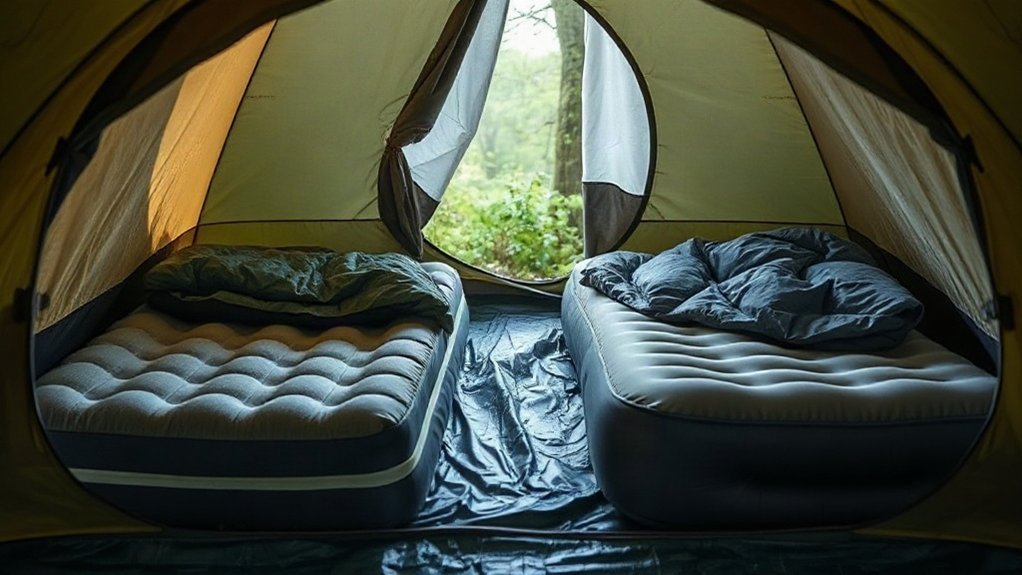
I match a pad’s R-value to the season: at least 3 for cool, damp spring and autumn nights, and around 5 or higher for winter. UK nights can turn cold even in July, with single-digit temperatures common in upland areas from autumn to spring. If you use an air mattress on a cool night, I recommend adding a foam mat or folded blanket underneath.
Match R-Value to Season
Because UK nights can turn cool and damp even outside winter, match your pad’s R-value to the season: it measures resistance to heat loss into the ground, and higher values provide more insulation. I use these ranges to choose a setup without carrying more insulation than I need:
- Mild, dry summer: An air mattress or sleeping pad can work; many air mattresses rate just R-1 to R-2.
- Spring and autumn: Choose an insulated pad rated at least R-3. Self-inflating mats typically range from R-2 to R-5; inflatables, R-2 to R-6+.
- Winter: Pair a sleeping bag rated to 0°C with a pad around R-5 or higher; some camping mattresses reach R-8+.
- Extra warmth: Put a foam mat or folded blanket beneath an air mattress. I check the tent floor setup alongside my camp quilt.
Choose for UK Conditions
Even in July, UK campsites can drop to 8–12°C overnight, so I choose a pad for the ground temperature, not the season’s daytime forecast. For mild, dry summer nights, either a sleeping pad or air mattress can work. I still check the forecast and ground conditions before I head out.
In spring and autumn, I choose a sleeping pad with an R-value of at least 3; single-digit temperatures are common in the Lake District, Peak District and Scottish Highlands. For winter, I use a well-insulated pad: a sleeping bag rated to 0°C is tested with a pad around R-value 5 or higher. Damp ground draws heat away faster, so I trust an insulated pad over an air mattress rated R-value 1–2. A foam mat beneath it helps. I also check my tent footprint, mummy shape and pad coupler for fit.
Frequently Asked Questions
Is a Sleeping Pad Better Than an Air Mattress for Camping?
Yes, I’d choose a sleeping pad for most camping, especially backpacking or cool, damp nights. It’s lighter and packs smaller, while better insulation helps protect you from cold ground; I’d look for an R-value of 3 or higher. An air mattress can feel more like a bed, so I’d consider one for a short, mild car-camping trip when comfort matters more than weight or warmth. You may need a pump and extra insulation.
What Is the Comfiest Thing to Sleep on When Camping?
For the comfiest camping sleep, I’d choose a thick foam-and-air mattress: at four inches, the Nemo Roamer offers plush cushioning that testers compared to a home bed. If you sleep on your side, I’d look for at least 8 cm (about 3 inches) of thickness to cushion your hips and shoulders. Test your usual position, adjust firmness, and choose a two-person model only if its weight and packed size suit your trip.
Is There Something Better Than an Air Mattress for Camping?
Yes—I’d choose an insulated sleeping pad for most camping trips. It weighs less, packs smaller, and keeps you warmer than a basic air mattress. For cool or damp conditions, I’d look for an R-value of at least 3; if you sleep on your side, an inflatable pad at least 8 cm thick can cushion your hips and shoulders. I’d reserve an air mattress for short, mild car-camping trips when extra cushioning matters most.
Are Sleeping Pads Worth It for Camping?
Yes, I think sleeping pads are worth it when you want to travel light and stay warm; they’re a small investment that can pay big dividends. I’d choose an insulated pad with an R-value of 3 or higher for cool, damp ground. Pads pack smaller, weigh less, set up quickly, and rarely deflate gradually. For side sleeping, I’d look for at least 8 cm of thickness. For mild car camping, an air mattress may suit you better.
Conclusion
Choose your sleep setup around the trip, not just the price. I’d take a compact, insulated sleeping pad for backpacking or cool UK nights, and an air mattress for car camping when comfort and space matter more. Match support to your sleep position, check the temperature rating, and practise packing and inflation at home. A hybrid can bridge the gap. The right choice is your campsite’s foundation: get it right, and the rest of the night is easier.
References
I can’t verify three publicly accessible, authoritative sources directly comparing camping sleeping pads and air mattresses, so I can’t provide references that meet the stated requirements without risking inaccurate links.