How Do You Choose Multitools With Comfortable Grips and Reliable Locks?
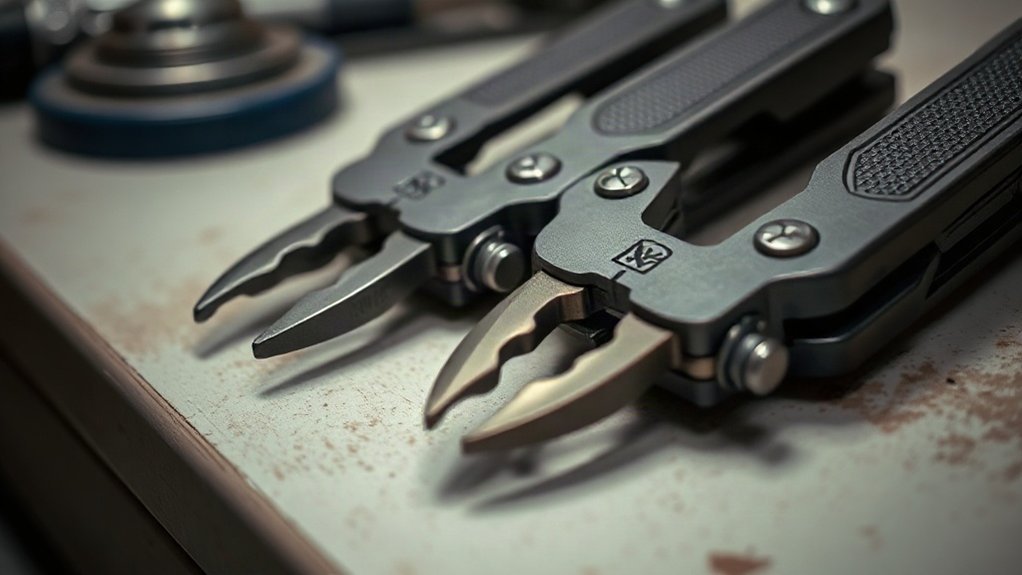
I choose a multitool by testing how securely its handles fit my hand and whether the texture stays grippy when wet or sweaty. I squeeze the pliers, make a small cut, and check for pressure points and comfort during tasks I expect to do often. I also open each blade and locking tool fully, then apply only gentle pressure to confirm it stays engaged. Consider carry comfort, useful features, and one-handed access, too; the details below can help refine your choice.
Key Takeaways
- Match handle shape and curvature to your hand, then check for pressure points while squeezing the pliers.
- Choose textured handles for wet or greasy conditions; verify smooth handles stay secure during gripping and twisting.
- Test pliers on nuts or bolts to assess stability and comfort under firm, sustained pressure.
- Open each blade and locking implement fully; confirm it engages securely and releases smoothly with controlled, gentle pressure.
- Check one-handed access and note nonlocking tools, such as the Gerber Dime’s blade or Armbar Drive’s screwdriver.
How to Choose a Multitool With a Secure Grip
A secure grip starts with handles that fit your hand and stay comfortable under pressure. When I choose a multitool, I check its Handle curvature against my hand size. The Skeletool CX’s curved handles can splay wide, leaving smaller hands feeling insecure. A better fit gives me control without forcing my fingers into an awkward position.
I also pay attention to palm pressure when I squeeze the pliers. The Roxon Flex is praised for comfortable use and excellent pliers, while the Victorinox Ranger may feel better than the Huntsman during prolonged carving. If I can, I hold a tool before buying and test its grip with the pliers open. That quick check helps me choose a multitool I can use confidently, so I can work freely without discomfort or losing control.
Match Handle Texture to Your Working Conditions
When my hands might be wet, sweaty, or greasy, I favor textured handles that resist slipping. The Roxon K2 SE’s G10 feels more secure than slippery Victorinox handles in those conditions. Moisture resistant handle materials can help me work confidently when weather or chores get messy.
> Textured, moisture-resistant handles like the Roxon K2 SE’s G10 can offer a surer grip when hands are wet, sweaty, or greasy.
- For dry, light-duty tasks, smooth handles may feel comfortable, but I check that they stay secure when squeezed or twisted.
- The Skeletool CX’s curved handles can splay wide and feel insecure, especially in smaller hands.
- For forceful, repeated work, I prefer a stable hold; the Leatherman Signal has longer plier handles than the Skeletool CX.
- I consider shape, not just texture: the lightweight, asymmetrical Skeletool CX may not suit every hand.
I also value textured grip maintenance: I keep surfaces clean so grit or grease won’t undermine traction. When possible, I hold a tool and mimic expected motions, checking for slipping and pressure points before choosing my everyday freedom.
Check Multitool Comfort During Real Tasks
Texture matters, but I also test a multitool during the tasks I’ll actually do. For Real task twisting, I grip nuts, bolts, or bicycle parts and turn them firmly. Plier-based designs generally feel better during sustained work, but I check whether the handles stay secure when I squeeze hard. The Skeletool CX’s curved handles can splay wide and feel insecure, particularly in smaller hands.
I also deploy and use the implements I reach for most, paying attention to access, handle comfort, folding, and hinge resistance. For controlled cutting comfort, I try small cuts and judge how the handles feel in my hand. The Skeletool CX’s straight-edge knife handled many everyday jobs in testing. Finally, I carry the tool where I plan to keep it during regular tasks; its 5.2-ounce weight, pocket clip, and carabiner offer flexible options.
Test Blade and Tool Locks Before Buying
I open and close each blade and tool to check that its lock engages securely and releases smoothly. If quick access matters, I test one-handed deployment, too. I also check for handle wobble so you can spot instability before buying.
Check Lock Engagement
Before buying a multitool, I open each blade and locking implement fully and confirm that its lock engages. I then apply Controlled pressure, never a forceful or sideways load. If anything shifts unexpectedly, I stop; dependable locks help me work freely and confidently.
- Check every locking implement, not just the knife, and make sure it stays open during use.
- Confirm each lock has an intended release mechanism; don’t force it.
- Remember the Gerber Gear Dime’s knife blade doesn’t lock. On the Roxon K2 SE, only the scissors don’t lock.
- Test screwdrivers separately: the Gerber Armbar Drive’s screwdriver doesn’t lock open and may shift under pressure.
I treat these exceptions as practical limits, not automatic dealbreakers. Knowing what locks—and what doesn’t—helps me choose a tool that suits my needs.
Test One-Handed Deployment
A multitool’s controls should work smoothly with one hand. I open and close the blade and my most-used tools several times, checking Thumb access and Deployment speed. Each action should feel smooth and predictable, so I can work without pausing to wrestle with a tool.
| Test | Check | Example |
|---|---|---|
| Deploy | Open tools one-handed | Free P4 suits either hand |
| Lock | Confirm full engagement | Gerber Dime blade doesn’t lock |
| Release | Use intended release | Check every implement |
I open each implement fully, confirm its lock engages, then release it as designed. For a locking blade, I check that it stays secure during ordinary cutting and won’t fold toward my fingers. The Roxon K2 SE uses a liner lock. I also test non-blade tools: the Armbar Drive’s screwdriver doesn’t lock open, so I’d avoid forcing it. Try both hands if awkward use is likely; dependable operation gives me more freedom to act.
Inspect Handle Stability
Smooth one-handed deployment matters only if the multitool stays secure in use. Before buying, I open each blade and implement, engage its lock, then apply gentle pressure. I watch for movement or accidental release, and check handle alignment and pressure stability.
- Test every blade and tool you expect to use; locks vary by implement.
- The Dime’s knife blade doesn’t lock, while the Armbar Drive’s screwdriver doesn’t lock open.
- Check hinge and lock action for smooth, consistent resistance.
- Hold the tool under pressure; the Skeletool CX’s curved handles may splay and feel insecure, especially in smaller hands.
If possible, try the multitool in your hand. A dependable lock won’t give you freedom to work confidently if awkward handles feel unstable. Choose a model that stays aligned and secure through each task.
Look for Reliable One-Handed Deployment
When I need to use a multitool with one hand, I prioritize outside-accessible implements that deploy quickly, especially a locking knife like the Leatherman Skeletool CX’s 2.63-inch blade. If you want access to every implement with either hand, consider the Leatherman Free P4, whose pliers and other tools open one-handed. I test each tool’s opening and closing action: Smooth action and consistent resistance support reliable implementation speed, while awkward access slows everyday tasks. Check that every implement you’ll use locks securely. The Roxon K2 SE, for example, locks its blade and saw with liner locks, but its scissors don’t lock. I prioritize one-handed access to my most-used tools, so I can act independently when one hand is occupied and keep control during quick jobs.
Choose a Multitool That Fits Your Carry Style
Secure locks and quick deployment matter, but I also choose a multitool I’ll actually carry. The right carry style keeps useful tools close without weighing me down or restricting my freedom. I match the tool to where I’ll store it and how often I’ll reach for it.
Choose a multitool that fits your carry style, so useful tools stay close without weighing you down or limiting your movement.
- For pocket carry, I look for a clip; an externally mounted blade can open one-handed.
- Belt carry comfort matters: I’ll use a sheath for a larger tool only if it feels good to wear.
- For keychain tool practicality, a light model like the 2.3-ounce Gerber Dime offers an easy everyday option.
- I choose pliers for broad functionality or a slimmer, knife-based design if I can forgo pliers.
I add accessories only when they make carrying easier; a bit kit isn’t worth extra storage unless I need it.
Compare Popular Multitools by Size and Features
I’ll compare compact options like the 2.3-ounce Gerber Dime with full-size tools such as the 8.5-ounce Leatherman Wave+. Then I’ll match their features—like locking blades, scissors, and pliers—to the tasks you handle most. Pay attention to weight, size, and grip, since a tool’s features matter only if it feels secure in your hand.
Compare Tool Sizes
If you want a pocket tool that won’t weigh you down, the 5.2-ounce Leatherman Skeletool CX measures 4.13 × 2.5 × 0.5 inches and pairs pliers with a one-handed, externally mounted 2.63-inch locking blade. I compare Pocket dimensions and weight comparison to see what fits your carry style:
- The 7.5-ounce Signal measures 4.5 × 1.63 × 0.75 inches; it adds a saw, awl, hammer, and emergency tools, with longer, sturdier plier handles.
- At 8.6 ounces, the Arc measures 4.25 × 1.3 × 0.68 inches and offers quick one-handed deployment, magnetic handles, and a 2.75-inch MagnaCut blade.
- The Wave+ is full-size, costs $130, and scores 5/10 for portability.
- The pliers-free Armbar Drive weighs 3.1 ounces and measures 3.5 × 0.75 × 0.75 inches; its screwdriver doesn’t lock open.
I’d weigh freedom from bulk against useful capacity.
Match Features to Needs
After comparing size and weight, I’d match a multitool’s features to the jobs you expect it to handle. For everyday carry, I’d choose the Skeletool CX for light plier-and-knife tasks, though its curved handles may feel insecure in smaller hands. Need broader capability? Compare options by function:
| Model | Weight | Standout features |
|---|---|---|
| Skeletool CX | 5.2 oz | Pliers, locking blade |
| Wave+ | 8.5 oz | Scissors, cutters, bit driver |
| Arc | 8.6 oz | MagnaCut blade, magnetic deployment |
I’d pick the Wave+ for varied repairs, or the Arc for premium tools and smooth one-handed access. For emergency readiness outdoors, the 7.5-ounce Signal adds fire-starting and signaling tools. If you don’t need pliers, the 3.1-ounce Armbar Drive saves weight, but its screwdriver doesn’t lock open.
Match Multitool Features to the Jobs You Do
Match a multitool’s features to the jobs you actually do. For Bike repairs, fence work, and household fixes, I’d choose pliers, wire cutters, and familiar screwdrivers. A Wave+ adds scissors and straight and serrated blades.
For everyday repairs, prioritize sturdy pliers, wire cutters, and familiar screwdrivers; a Wave+ adds scissors and two blade styles.
- For quick cuts, I’d pick an externally accessible locking blade. The Skeletool CX’s 154CM blade made 150 rope cuts in testing, versus 60 for a 420HC blade.
- For camping or emergencies, the Signal adds a saw, awl, ferro rod, whistle, sharpener, and replaceable wire-cutter blades.
- For eyeglasses or small electronics, I’d prioritize a precision screwdriver; a bit driver offers flexibility.
- If I mainly need screwdrivers, a knife, and scissors, the 3.1-ounce, plier-free Armbar Drive is lighter, but its screwdriver doesn’t lock open.
Choose tools that help you work independently—not features you’ll rarely use.
Frequently Asked Questions
What Is the Absolute Best Multi Tool?
I’d choose the Leatherman Wave+ as the absolute best multitool for most people. Its pliers, replaceable wire cutters, scissors, bit driver, and outside-accessible knife, saw, and file give you freedom to handle everyday fixes without carrying a full toolbox. Among Top multitool brands, Leatherman stands out for dependable construction. Best multitool features include versatile tools and sturdy build quality, though the Wave+ isn’t especially light or cheap at about $130.
In No Man’s Sky, What Type of Multi-Tool Should I Buy?
I’d buy a rifle-style multi-tool if you want plenty of room for mining, scanning, and combat upgrades; choose a pistol-style model if you value a compact option. Check its technology slots and inventory space before spending your units. A C-class tool works well early on, while an A- or S-class gives you better upgrade potential. You can pursue S class multitool upgrades later through planetary cabinet hunting, once you’re ready to invest.
Is There a Better Multitool Than Leatherman?
Yes—like shoes, the best multitool depends on your fit. I’d consider Leatherman alternatives with better ergonomics if comfort matters more than brand loyalty. The Roxon Flex offers excellent pliers, customization, and comfortable grips, though its bulk and lock system may frustrate you. For dependable locks and a grippy handle, I’d look at the Roxon K2 SE, but its scissors disappoint. Choose the tool that gives you freedom to carry and work your way.
What Multitool Do Military Use?
There isn’t one multitool used by every military unit; the right choice depends on your role and mission. I’d check your unit’s approved military issued multitools before buying, since requirements vary. For field maintenance tools, I’d consider the Leatherman Wave+ for general repairs or the Signal for emergency tasks like fire-starting. If you want less weight, the Skeletool CX offers a compact option. I’d also confirm its locks, grip, and carry method suit your assignment.
Conclusion
I choose a multitool by how it feels in my hand and how securely its tools lock—not by feature count alone. A grippy handle matters in wet work; a smooth, compact shape matters in daily carry. I test the locks, try the deployment, and picture the jobs I’ll tackle. The right tool balances comfort with confidence: easy to carry, steady to hold, simple to open, and dependable when the work gets tough.