Which Multitools Offer the Most Useful Features for Emergency Situations?
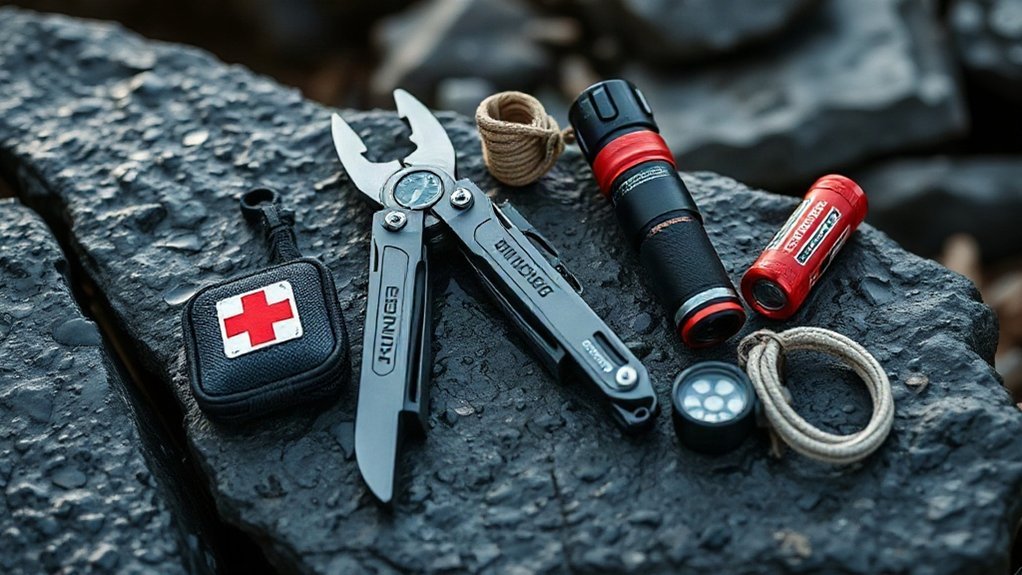
I’d choose an emergency multitool for the problems I’m most likely to face, not simply for its feature count. The Leatherman Signal offers pliers, cutters, a knife, a saw, a ferro rod, and a whistle for outdoor emergencies. For light carry, the Gerber Dime handles minor fixes, while the heavier Leatherman Surge suits demanding repairs. I’d also check grip, blade access, and carry weight, then practice using the tool before an emergency. Each option’s strengths become clearer with a closer comparison.
Key Takeaways
- Leatherman Signal suits wilderness emergencies with pliers, cutters, a knife, a saw, a ferro rod, a whistle, and a sharpener.
- Leatherman Surge offers heavy-duty capability for stubborn repairs, but its 12.2-ounce weight makes it less convenient to carry.
- Gerber Dime provides a lightweight, affordable backup for minor fixes, with pliers, scissors, screwdrivers, and a clamshell cutter.
- For vehicle emergencies, choose a tool with a belt cutter and glass breaker; pliers and a long screwdriver can help with repairs.
- Match features to likely emergencies, practice using locks and tools beforehand, and remember a multitool cannot replace first-aid supplies or training.
How to Choose an Emergency Multitool
How should you choose an emergency multitool? I start with the problems I might face, not a long list of features. Pliers, wire cutters, a locking knife, and screwdrivers handle common repairs; a saw or can opener can support shelter and food tasks. For an Emergency Kit meant for outdoor use, I might consider the Leatherman Signal, which adds a saw, awl, ferro rod, whistle, and sharpener. It weighs about 7.5 ounces and has a 2.75-inch blade.
My Tool Selection also weighs durability against freedom to carry the tool comfortably. The 12.2-ounce Leatherman Surge suits heavy-duty work, while the 2.4-ounce Gerber Dime is easier to carry for small tasks. I check materials and replaceable parts, practice the locks, and maintain the tool before I depend on it.
Which Multitool Features Matter Most?
Once you’ve chosen a multitool you can carry, focus on features you’ll use reliably. I’d prioritize practical tools over a long feature list, so you can handle repairs without carrying unnecessary weight. Tool durability and grip comfort matter: a sturdy tool that feels secure in your hand is easier to use when conditions turn difficult.
- For common fixes, choose pliers, wire cutters, a locking knife, and Phillips and flat screwdrivers.
- For camp tasks, a saw and can opener help with shelter-building and food preparation. A straight-edge blade is usually easier to sharpen than a serrated one.
- For vehicle emergencies, a belt cutter and glass breaker can support escape; strong pliers and a long screwdriver help with repairs.
Match features to your situation, and keep your go-bag light enough to move freely.
Leatherman Signal: Best for Outdoor Emergencies
I’d consider the Leatherman Signal for outdoor emergencies because it combines pliers, cutters, a knife, a saw, and a hammer. Its built-in ferro rod, whistle, and sharpener add fire-starting and signaling options without much bulk. At about 7.5 ounces, it’s easy to carry, while its larger pliers and replaceable cutters offer robust performance.
Emergency-Ready Toolset
When outdoor emergencies call for more than basic repairs, I’d choose the Leatherman Signal for its survival-focused kit. Its broad toolset helps you stay capable when a trail mishap or equipment failure threatens your freedom to keep moving. I value the robust pliers, longer handles, and replaceable wire cutters for demanding repairs.
- Use the knife, saw, awl, and hammer for practical camp and gear tasks.
- Reach for the screwdrivers, wrenches, and openers to fix equipment or access supplies.
- Keep the sharpener handy to maintain the blade for outdoor work.
At about 7.5 ounces, it’s manageable to carry, with a 2.75-inch blade. In Cold weather, gloves can complicate fine tasks; practice using the tools beforehand. For medical response, it can help prepare materials, but it isn’t a substitute for first-aid supplies or training.
Fire-Starting and Signaling
Beyond repairs, the Leatherman Signal adds practical fire-starting and signaling tools for outdoor emergencies. I value gear that helps me stay self-reliant when plans change, and its removable ferro rod gives me a dependable way to spark tinder. With the included striker, I can practice Fire starting techniques before heading out, so I’m better prepared to make a fire when I need one.
The emergency whistle gives me a simple option for signaling methods if I’m separated from others or need help. Both tools fit securely in the handle, alongside the Signal’s core pliers, knife, and saw. A diamond-coated sharpener helps me maintain its 2.75-inch blade in the field. At about 7.5 to 7.6 ounces and $150, it brings useful emergency functions in a manageable package for outdoor carry.
Robust Outdoor Performance
For outdoor emergencies, I want a multitool that can handle more than small fixes. The Leatherman Signal gives me the reach and strength to tackle demanding tasks without weighing down my pack. Its Load bearing construction supports tougher work, while corrosion resistance matters when I’m exposed to wet conditions.
- Larger pliers, longer handles, and replaceable wire-cutter blades help me grip, cut, and repair gear.
- The 2.75-inch knife, saw, and awl support cutting, outdoor repairs, and shelter tasks.
- At about 7.5–7.6 ounces and 4.5 inches closed, it balances capability with packable size.
I can also use its hammer and openers for practical camp jobs. When conditions change, I’m better equipped to adapt, solve problems, and keep moving under my own power.
Gerber Dime: A Compact Backup Multitool
I’d keep the Gerber Dime on my key ring: at about 2.3 ounces, it folds down to just 2.75 inches long. Its 12 tools handle everyday needs, from small gripping jobs to opening packaging and bottles. The knife doesn’t lock, so I’d use care and save it for light tasks.
Compact Key-Ring Carry
The Gerber Gear Dime is a compact backup that clips onto your key ring without taking up much space. At 2.75 × 0.81 × 0.5 inches and about 2.3 ounces, it keeps your carry light and your options open. For Key organization and pocket accessibility, it fits alongside your keys or in a small EDC kit without demanding a dedicated pocket.
- Its compact profile adds little bulk when you’re moving freely.
- The externally mounted bottle opener is quick to reach.
- Precise plier jaws can grip or pull small items when needed.
I’d treat the Dime as a backup for minor fixes, not a heavy-duty emergency tool. Its non-locking knife blade isn’t suited to forceful cutting, and its small size limits demanding tasks. Typically under $30, it’s an affordable way to keep a little extra capability close at hand.
Useful Everyday Tools
A dozen tools make the Gerber Dime useful for everyday fixes and light emergency tasks. I like its everyday convenience: pliers with precise jaws handle small grabs, while scissors and two screwdrivers support routine maintenance. The externally mounted bottle opener is quick to reach, and the clamshell cutter helps free purchases from retail packaging.
| Tool | Useful task |
|---|---|
| Pliers | Grip small items |
| Scissors | Trim light materials |
| Screwdrivers | Tighten small screws |
| Bottle opener | Open drinks quickly |
| Clamshell cutter | Open retail packaging |
Its knife and other tools suit minor jobs, not heavy-duty fieldwork. I’d keep the Dime handy for quick fixes, so I can handle small snags independently without carrying a full-size kit. At about 2.3 ounces, it’s a practical backup for daily use and light emergencies.
Nonlocking Blade Limitation
For quick fixes, the Gerber Dime’s 1.38-inch blade can handle light cutting, but it doesn’t lock, so I use extra care and avoid relying on it for heavy-duty emergency tasks. Without Blade locking mechanisms, the blade may fold under pressure, so I keep cuts controlled and work away from my body for puncture injury prevention.
- I reserve the blade for opening packages, trimming cord, or other light jobs.
- For tougher cutting, I choose a sturdier locking knife rather than force the Dime.
- I use its precise pliers, scissors, clamshell cutter, or screwdrivers when those tools fit the task.
At 2.75 inches folded and about 2.3 ounces, the Dime rides easily on my key ring, usually for under $30. I value that freedom to carry a capable backup, while keeping its limits clear.
Leatherman Surge: Best for Heavy-Duty Repairs
When your repairs demand more strength than an easy carry, the Leatherman Surge stands out. I’d choose it when a broken tool, damaged shelter, or stubborn repair calls for serious capability. Leatherman’s largest multitool weighs 12.2 ounces, and its robust construction is built to handle demanding work. You’ll get a capable companion for situations where self-reliance matters more than convenience.
In a Rebar comparison, I’d focus on how much strength and capability your repair tasks require, rather than assuming one tool suits every kit. Blade accessibility also deserves attention when you need to work quickly. The Surge was the most-selected multitool among contestants on *Alone*, and those carrying one had a higher win percentage than those who didn’t. That’s no guarantee, but it’s a compelling sign of its practical value.
Compare Multitool Weight and Portability
Choosing an emergency multitool means balancing capability against the weight you’ll carry. I’d consider Pocket weight and carry comfort before adding any tool to your kit. A lighter choice gives you more freedom to carry it daily; a heavier one brings more capability but can cause pack fatigue.
“Balance emergency multitool capability with pocket weight and carry comfort to find a tool you’ll actually carry.”
- Gerber Dime: At 2.3–2.4 ounces and 2.75 inches folded, it’s the most pocketable pick and suits keychain carry.
- Leatherman Skeletool CX: At 5.2 ounces, it offers everyday portability with pliers and a locking knife.
- Leatherman Signal: Its 7.5–7.6 ounces add emergency features while staying lighter than full-size tools.
The Surge weighs 12.2 ounces, so I’d expect its weight to stand out in a go-bag. For light backup, choose a 2–3-ounce tool; for more capability, accept the space and weight of a 7–12-ounce plier tool.
Match Your Multitool to Likely Emergencies
Weight and portability matter, but I’d match a multitool’s features to the emergency you’re most likely to face. For Wilderness survival, the 7.6-ounce Leatherman Signal combines pliers, a saw, a knife, a ferro rod, an emergency whistle, and a sharpener, giving you tools for shelter, fire, and signaling. For vehicle escape, I’d prioritize a glass breaker and belt cutter; they matter more than a general-purpose saw or file when you need to exit quickly. In a car kit, strong pliers and a long screwdriver can handle repairs, while those escape features add safety. For first aid, scissors can cut clothing, bandages, or belts; some rescue-oriented models also include a belt cutter or oxygen-tank key. I’d choose the Gerber Dime as a light everyday backup, not for demanding fieldwork.
Keep Your Emergency Multitool Ready to Use
An emergency multitool only helps if it’s ready when you need it. I keep mine dependable with a simple cleaning routine and regular maintenance checks, so I can rely on it when circumstances demand quick action.
Keep your emergency multitool clean, maintained, and ready, so it works reliably when quick action matters.
- Wash away grit with warm, soapy water and a soft brush, paying attention to hinges, blades, and crevices. Dry the tool thoroughly, then oil its joints and moving parts to discourage rust and guarantee smooth opening.
- Check screws, locking mechanisms, and worn components. Tighten anything loose, and replace parts that are damaged or weakened. Sharpen straight blades at their original bevel with a diamond or ceramic stone; use a tapered file or rod on serrations.
- Store your multitool in a dry sheath or pouch. I also test its whistle and fire starter periodically, so these emergency features won’t let me down when I’m counting on them.
Frequently Asked Questions
What Is the Best Multi-Tool for Survival?
I’d choose the Leatherman Signal as the best survival multi-tool because it balances practical strength with useful emergency features. Its pliers, cutters, knife, saw, and hammer handle repairs and Emergency shelter tasks, while the ferro rod and whistle support fire-starting and wilderness signaling. At about 7.5 ounces, it’s easier to carry than the heavier Surge. If you value freedom to roam without excess weight, the Signal gives you capable tools without weighing you down.
What Is the Best Multitool for Value for Money?
I’d choose the Gordon 20-in-1 for the best multitool value: imagine fixing a loose bike rack on a weekend trip without buying a premium tool. At about $40, it offers a Wave+-like layout, weighs 8.6 ounces, and has held up through more than a year of use. That’s impressive Affordable tool durability and a strong budget feature comparison, leaving you more freedom to tackle everyday repairs without overspending.
What Is the Best Multitool for Survival?
I’d choose the Leatherman Signal as the best survival multitool. Its 19 tools include pliers, wire cutters, a knife, a saw, a hammer, a sharpener, a whistle, and a removable ferro rod for fire starting. At 7.6 ounces, it’s easier to carry than the heavier Surge, while helping you build emergency shelter and signal rescuers. Before heading out, practice using its locks, whistle, and ferro rod so you can rely on them when freedom and safety matter.
What Is the Most Versatile Multi-Tool?
I’d call the Leatherman Wave+ the most versatile multi-tool for most people. Its pliers, replaceable wire cutters, straight and serrated blades, scissors, bit driver, and outside-accessible tools cover everyday tasks and Field Repairs without limiting you to one specialty. I value its balance of capability and portability, too. For Rapid Deployment, you can reach key tools quickly, while its broad toolkit gives you freedom to handle unexpected jobs at home or outdoors.
Conclusion
The best emergency multitool isn’t the one with the longest feature list; it’s the one you can carry, use, and trust when plans go sideways. I’d match its tools to the emergencies I’m most likely to face, then keep it accessible and ready. A Signal can answer the call outdoors, a Dime can ride along unnoticed, and a Surge can tackle tougher repairs. Pick your reliable pocket ally now—before a small snag becomes a storm.