How Can You Choose Machetes and Kukris for Gardening and Land Clearing?
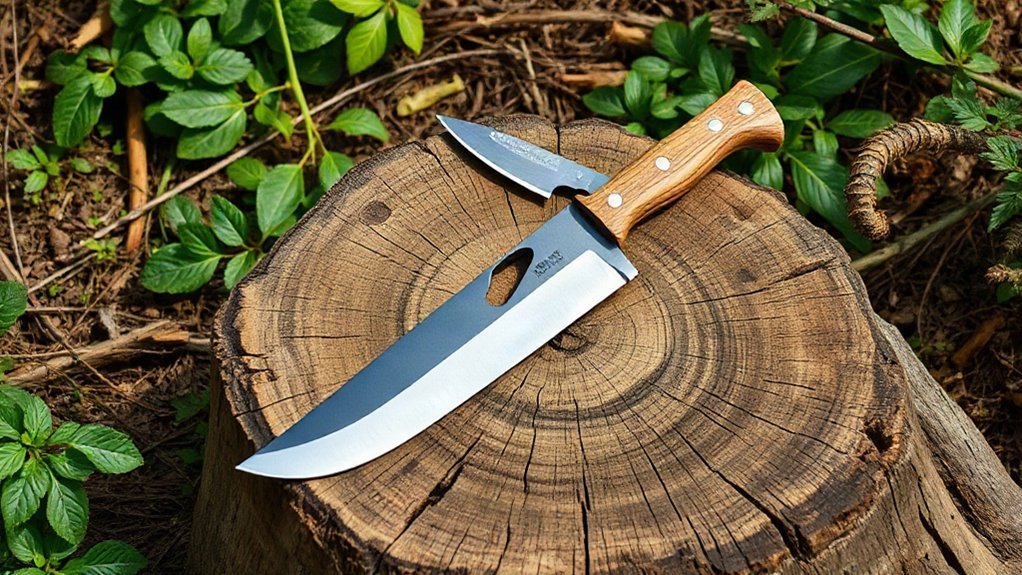
I choose a straight, lightweight 16–18-inch machete for grass, vines, and soft brush, then switch to a forward-weighted bolo or kukri for dense, woody stems. An 18-inch blade is versatile, while shorter blades offer better control in tight spaces and longer ones add reach but can tire my shoulder. I match steel and construction to the workload, favoring a sturdy full tang for chopping. I also use safe cutting techniques and switch to a saw or loppers for larger stems. The right details make choosing easier.
Key Takeaways
- Match the blade to vegetation: use a lightweight Latin machete for grass and vines, and a forward-weighted bolo or bush blade for dense, woody stems.
- Choose a kukri for controlled chopping of dry hardwood brush and saplings; switch to loppers or a saw for stems over 3–4 inches.
- Balance reach and control: 14–16-inch blades suit tight spaces, while an 18-inch blade works well for many clearing tasks.
- Select durable construction for demanding work: consider full tangs, secure handles, and tough carbon or spring steel suited to repeated impacts.
- Work within the tool’s limits: clear the swing path, use controlled cuts, wear eye protection and cut-resistant gloves, and keep others well back.
Match Your Blade to the Vegetation
Choose a blade based on what you’ll cut: a Latin-style machete swings quickly through grass, vines, and light green brush, but may bounce off woody stems. I’d match your tool to vegetation thickness and stem toughness so you can work efficiently and stay in control.
For stems thicker than about ¾ inch, I’d reach for a forward-weighted bolo or bush machete. Its extra chopping impact can handle woody growth better than a light, straight blade. A kukri’s recurved, forward-weighted blade also suits woody stems, saplings, and dry hardwood brush; suitable models can cut saplings about 3–4 inches across.
In wet tropical growth, a parang or golok may serve you well, but these patterns are less suited to tough North American brush like alder, hawthorn, and autumn olive. When stems exceed roughly 3–4 inches, I’d use loppers or a pruning saw. They’ll cut larger growth more efficiently and give you freedom to clear your land with less effort.
Choose a Machete or Kukri for the Job
I match the blade to the vegetation: a straight machete sweeps through grass, while a bolo or kukri handles woody stems. I consider reach and weight, choosing a shorter blade for tight spaces and a longer one when extra reach is worth the fatigue. I also factor in terrain and brush size, switching to loppers or a saw for larger branches.
Match Blade to Vegetation
Match the blade to the vegetation: I use a long, thin Latin-style machete for grass, vines, and light green brush, but it can bounce off dense woody stems such as alder or hawthorn. Its quick cuts give me excellent Grass cutting speed, though I watch stem thickness limits rather than forcing it through tough growth.
For heavy stalks or woody stems over about ¾ inch, I choose a forward-weighted bolo or bush machete; its chopping momentum handles denser growth. A recurved, forward-weighted kukri concentrates force on woody brush and saplings, and suitable models can cut stems around 3–4 inches thick. In wet tropical growth, I’d consider a parang or golok. For dry North American hardwood brush, I prefer a kukri or heavy bolo. Above roughly 3–4 inches, I switch to loppers or a pruning saw.
Consider Reach and Weight
For versatile yard clearing, I reach for an 18-inch machete; a 14–16-inch blade gives me more control in tight spaces, while a 20–24-inch model adds reach but can tire my shoulder.
I weigh freedom of movement against the work ahead. Longer blades offer extended reach, help me avoid bending, and keep me farther from thorny plants, but can feel unwieldy. I choose by task:
- For long brush-clearing sessions, I favor a 300–500-gram machete for reduced fatigue.
- For grass and light brush, I pick a light, straight blade and move freely.
- For dense stems or saplings, I use a forward-heavy machete to gain chopping momentum.
- For woody growth, I choose a 10–14-inch kukri, usually weighing 400–600 grams.
Its forward-weighted design chops well, but I don’t rely on it to sweep broad areas.
Choose for Terrain
When I choose a blade for the terrain, I consider what I’m cutting: a straight Latin-style machete sweeps quickly through grass, vines, and light brush, while a forward-weighted bolo or kukri delivers more force against thick stalks and saplings.
For a practical terrain assessment, I also check ground conditions and working space. In mixed terrain with dry hardwood brush, I favor a sturdy kukri or heavy bolo; for soft growth and lowland jungle, I’d choose a faster machete. Dense brambles call for an 18–24-inch blade to keep thorns at a safer distance, but I avoid long blades in tight spaces. A bolo or kukri can handle stems around three to four inches across. For larger stems, I switch to loppers or a pruning saw, especially above 1.5–2 inches, and clear the land with greater control.
Choose a Blade Shape for Woody Growth
For dense growth, I’d choose a panga over a long, thin Latin blade that can bounce on woody stems. For thicker brush, a forward-weighted bolo delivers more chopping force, especially on stems over about ¾ inch. When I need controlled chopping on saplings or dry hardwood, I’d reach for a recurved kukri; use loppers or a pruning saw for larger stems.
Panga For Dense Growth
If dense growth includes thick branches, saplings, and tangled shrubs, choose a panga: its broad, forward-weighted blade delivers concentrated chopping force and can clear the work with fewer swings than a long, thin Latin blade designed for grass and light brush.
I find the panga blade design especially useful when dense growth challenges block a path or crowd a garden. It helps me reclaim space without endless hacking, but I still choose carefully:
- For woody stems over about ¾ inch, the weight gives each controlled swing useful impact.
- High-carbon steel can stand up to repeated chopping.
- A contoured, shock-absorbing handle helps me keep a secure grip and work with confidence.
- For stems around 3–4 inches, I consider a heavy bolo or kukri; for larger ones, I reach for loppers or a pruning saw.
With the right tool, I can open a route and move freely.
Bolo For Thick Brush
Though a panga suits dense growth, I reach for a bolo when woody stems call for focused chopping power. Its blade bulges toward the tip, and that bolo weight distribution puts more mass behind the edge. I find it useful for thick stem cutting through brush, small saplings, and heavy-stalked plants, especially when stems exceed about ¾ inch.
A heavy bolo can handle growth up to roughly 3–4 inches, but I switch to loppers or a pruning saw for larger branches. A forward-heavy Tramontina Bolo, typically 15–18 inches and $20–$35, builds chopping momentum; Condor’s 15-inch model has 3–3.5 mm-thick 1075 steel. That weight can speed work in woody patches, though I feel the fatigue sooner when clearing grass. I choose the tool that lets me clear efficiently and keep moving freely.
Kukri For Controlled Chopping
When woody growth calls for controlled chopping, I favor a recurved kukri: its forward-curved blade concentrates force at the contact point, making it effective on saplings and dry hardwood brush. A forward-weighted profile and substantial edge give me control; I wouldn’t choose a slim blade meant mainly for grass. For stems around 3–4 inches, a kukri-style blade or heavy bolo can work. I reach for loppers or a pruning saw on larger growth.
- Clear the swing path so each Controlled swing stays safe.
- Check target placement before striking near plants or uneven ground.
- Choose a compact kukri when tight spaces demand precise trimming.
- Accept its shorter reach; it won’t sweep broad areas efficiently.
With a sound blade choice and deliberate aim, I can shape woody growth while keeping the freedom to work confidently on my land.
Find the Right Blade Length and Weight
What you’re clearing should guide your choice of blade length and weight. I find an 18-inch machete versatile for most yard work. When choosing blade length, I’d go shorter—14–16 inches—for tight spaces where control matters. For larger areas, 20–24 inches offers extra reach, though the longer swing may tire my shoulder. If I’m clearing brush often, a 22–24-inch blade can keep me farther from thorns and reduce bending, but I’d make sure it doesn’t feel unwieldy.
For kukris, a 12.5-inch MK4 weighs about 400–450 g, while an M43 weighs 590–680 g and delivers more chopping power with a heavier swing. A working kukri typically weighs 400–600 g; a quality machete, around 350–500 g. When balancing blade weight, I favor lighter tools for long sessions and heavier, forward-weighted ones for woody stems. Match the tool to your terrain and workload, so you can move freely without tiring too soon.
Compare Steel for Edge Life
Once you’ve settled on a blade’s length and weight, compare its steel for edge life and ease of upkeep. I match steel to the work so I can spend more time clearing my own path and less time sharpening.
- 1075 carbon steel balances toughness and edge retention for sustained chopping. I’d expect a touch-up after about 45 minutes of hard brush work.
- 1095 steel may hold its edge slightly longer, but it’s less tough and can suffer more damage during repeated hard chopping.
- 5160 spring steel suits a kukri when impacts are heavy. It absorbs shock, keeps its edge well, and is easier to sharpen than some alternatives.
- 420HC stainless resists rust with little maintenance, but dulls faster under sustained cutting. I’d choose it for lighter garden work.
Your sharpening intervals also depend on the plants. Dry hardwood, hawthorn, and autumn olive dull blades faster than soft green growth. After 45–60 minutes of hard brush work, I’d check the edge and touch it up.
Check Handles, Tangs, and Build Quality
I check the tang first, since a thin rod tang can fail under hard chopping or batoning. Then I assess the handle for a secure, non-slip grip and materials that can withstand moisture and sun. For demanding work, I favor firmly pinned scales and sturdy construction over price alone.
Inspect the Tang Construction
When you inspect a machete or kukri, check how far the blade’s tang extends into the handle. I favor Full tang construction for demanding chopping because the steel supports the handle along its length. That solid connection gives me greater confidence when I’m clearing land on my own.
- Look for pinned handle security; pins hold more reliably than glue alone.
- Check that the handle fits tightly, with no gaps or movement.
- Inspect the bolster and handle for cracks or looseness. Poorly built kukris have failed near the bolster, turning a useful tool into a hazard.
- Avoid a thin rod tang concealed inside a hollow handle; hard baton strikes can cause it to fail.
A careful inspection helps me choose a dependable tool and work with greater freedom, not worry about sudden breakage.
Check Handle Materials
Choose a handle material that suits your grip and storage conditions: traditional kukris may have rosewood, buffalo horn, or micarta handles, while machetes often use wood, polymer, or polypropylene. If you store your tool outdoors, I’d favor rubber-overmold or polymer for better moisture resistance and UV protection than wood. Whatever you choose, test it for a secure grip; comfort helps you control a forward-weighted blade and work confidently.
Before buying, I inspect the handle-to-blade junction for looseness, cracks, or poor fit. For demanding chopping, I look for a robust full tang with pinned scales, not a thin rod tang in a hollow handle or scales held only by glue. Weak construction can fail at the bolster during hard strikes, so I won’t trade dependable build quality for a low price.
Use a Kukri to Chop Wood
A kukri’s forward-weighted build and recurved belly deliver strong, focused chopping force, making it useful for seasoned hardwood and branches around 3 inches thick. I choose one with a substantial, convex edge to concentrate each strike. For larger stems, I reach for a saw or axe instead; the right tool keeps the work efficient and safe.
When I shop, I look for full-tang construction and tough steel, such as 5160 spring steel, which resists impact damage while holding a usable edge. Differential hardening can balance a strong edge with a more flexible spine.
- Feel the freedom: A well-chosen kukri lets me tackle small wood jobs without hauling bulky tools.
- Aim with care: I use controlled swings and avoid glancing blows; the force demands precision.
- Check the build: A sturdy tang and impact-resistant steel support dependable chopping.
- Know the limit: I switch tools when wood exceeds the kukri’s capacity.
I wear eye protection, clear my swing path, and keep others well back.
Use a Machete to Clear Green Brush
For fast clearing of grass, vines, and light green brush, I reach for a straight, lightweight Latin-style machete, usually 16–18 inches long. That length gives me room for sweeping cuts without limiting my freedom to move.
| Growth | Blade choice | Approach |
|---|---|---|
| Light brush | 16–18-inch Latin | Sweep cleanly |
| Tight spaces | 14–16-inch blade | Control each stroke |
| Dense stalks | Bolo or bush | Use added momentum |
An 18-inch blade suits most jobs; blades over 20 inches can tire my shoulder. For woody green stems, I choose carbon steel at least 3 mm thick. I cut stems diagonally with a controlled flick, clearing the swing path first. These clearing techniques help me work efficiently, but brush safety comes first: I wear eye protection and cut-resistant gloves. For stems over roughly 3–4 inches, I switch to loppers or a pruning saw rather than forcing a machete through.
Sharpen and Maintain Your Garden Blade
After hard brush work, I touch up my machete edge every 45–60 minutes and plan a full sharpening every two to four sessions, depending on the vegetation. Regular edge sharpening keeps each swing efficient, so you can spend less time fighting dull steel and more time shaping your land.
- Choose your angle: I use 25–30° per side for heavy chopping, or 20–22° for cleaner cuts through green growth.
- Build the edge: I start with a mill bastard file, refine it with a 400-grit whetstone, then finish on a leather strop.
- Inspect often: Dry hardwood, hawthorn, and autumn olive wear an edge faster than soft green growth. I check more often to avoid frustrating, tiring cuts.
- Protect the blade: I remove sap or resin with mineral spirits, dry the steel, and wipe carbon steel with mineral oil for rust prevention.
With a keen blade and simple care, I can clear brush confidently and keep my work moving on my own terms.
Handle and Store Your Blade Safely
When I’m clearing brush, I wear ANSI A4 cut-resistant gloves and eye protection, keep others outside the blade’s swing path, and hold the handle firmly. For safe blade handling, I choose a secure, comfortable grip, such as a non-slip polymer or rubber-overmold handle. That extra control matters during long sessions and wet work, when a slick grip can put your freedom to work at risk.
I use a sheath whenever I transport or store a machete or kukri, and I keep the blade sheathed in my vehicle. Before storage, I wipe a carbon-steel blade dry and apply mineral oil to help prevent rust. If sap or resin clings to the edge, I remove it with mineral spirits, then dry and oil the blade. These simple storage precautions keep my tool protected and ready for the next job. I also store it where the sheath stays secure and the edge won’t contact other gear or invite accidental handling.
Frequently Asked Questions
Can I Buy a Machete for Gardening?
Yes, you can buy a machete for gardening, and I’d choose one suited to your space and the plants you’ll cut. An 18-inch, 1075-carbon-steel model works well for many garden tasks; pick a shorter blade for tighter areas. Compare Machete blade materials, handle comfort, and balance before buying. I’d wear eye protection and cut-resistant gloves, clear my swing path, and follow Garden machete maintenance instructions to keep the tool safe and ready.
Is a Kukri or Machete Better?
I’d choose a machete for grass, vines, and light brush; I’d pick a kukri for woody stems and focused chopping. Your best option depends on the growth you’re clearing: a machete’s long blade sweeps quickly across broad areas, while a kukri’s forward blade balance boosts cutting efficiency on tougher growth. For mixed yard work, I’d favor an 18-inch machete. For larger stems, I’d use a saw or loppers instead, giving you more freedom and control.
What Is the Best Machete for Clearing Trails?
For most trail clearing, I’d choose an 18-inch, 1075-carbon-steel Latin machete: it’s a reliable workhorse for grass, vines, and light brush cutting without weighing you down. Common Imacasa models cost about $15–$22, leaving more room in your pack for adventure. If you face dense, heavy stalks, I’d switch to a forward-weighted bolo. Wear eye protection and cut-resistant gloves, clear your swing path, and sheath the blade for transport.
Can I Legally Own a Machete?
Yes, you can generally own a machete for yard work on private property in all 50 U.S. states. I’d still check current state and local Ownership laws, because rules may limit blade length or concealed carry. Ownership doesn’t automatically permit public carry. Before transporting one, I’d keep it sheathed and check applicable vehicle rules or agricultural-tool exemptions. I’d also review local Storage requirements and secure it responsibly at home, especially around children.
Conclusion
I choose a machete or kukri by matching its shape, length, and weight to the plants I need to clear. A light machete sweeps through green brush; a heavier kukri bites into woody stems and small logs. I once cleared a tangled garden path with the wrong blade and spent twice as long wrestling vines. Since then, I’ve treated blade choice like choosing the right key: the fit makes hard work feel manageable. Keep the edge sharp, grip secure, and blade safely stored.