What Should You Look for When Buying Military-Style Knives?
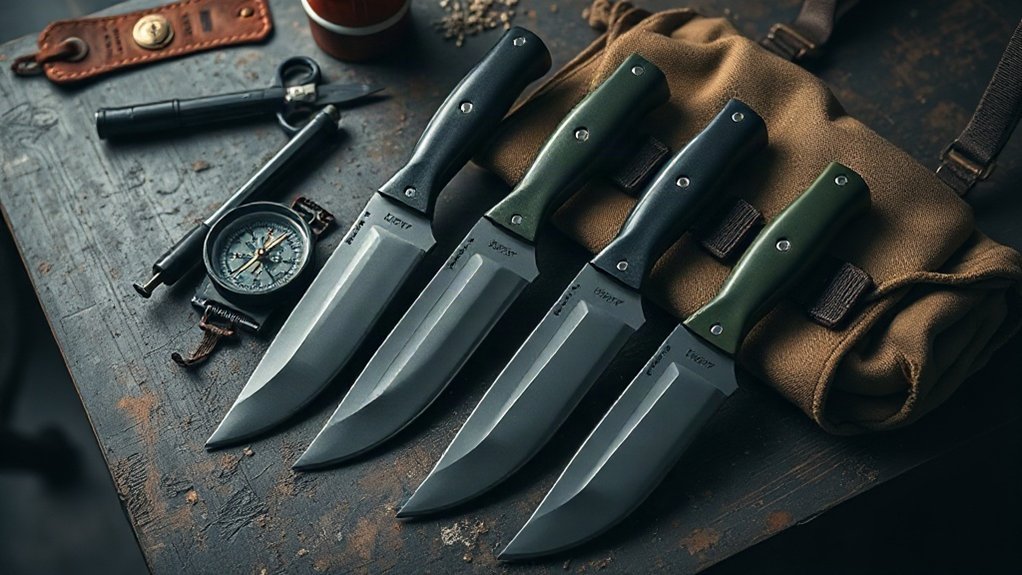
I’d start by matching the knife’s size and type to the work and carry you expect. For camp chores or impact, I’d favor a well-made full-tang fixed blade; for pocket carry, a folder may suit you better. I’d check the blade shape, even grind, steel grade, and hardness, then inspect the handle and sheath for secure, comfortable fit. I’d verify military markings and provenance rather than trusting labels alone, and confirm the seller’s condition and warranty details. The checks below can help narrow your choice.
Key Takeaways
- Match the knife’s blade length, weight, and type to your tasks and carry needs; prefer a full-tang fixed blade for demanding field use.
- Check that the blade shape, grind, and edge suit your work, with even bevels and no visible grinding irregularities.
- Verify the steel grade, credible heat-treatment information, and tang construction; balance edge retention, toughness, corrosion resistance, and sharpening ease.
- Inspect the handle and sheath for secure fit, comfortable grip, sound construction, and safe, reliable carry.
- Verify military claims against markings, maker, dates, and provenance; compare specifications and condition with reliable references, and review seller terms.
Choose a Military-Style Knife for Your Needs
Choose a military-style knife by matching it to the work you expect it to do: a compact fixed blade handles carving and food prep, while a thicker blade suits heavy camp chores but feels less nimble for fine tasks. I’d define your Intended use first, then weigh strength against carry comfort. A full-tang fixed blade offers a sturdy, portable option, while folders pack more easily but aren’t ideal for impact or stress.
Consider what you’re willing to carry: the 4.1-inch Gerber StrongArm Camp weighs 4.8 ounces, compared with the 5.25-inch KA-BAR BK2 at 16 ounces. Choose a blade length and weight that won’t burden your plans or limit your freedom to move.
Match steel to your conditions. Stainless 420HC suits damp use; 1095 Cro-Van and SK-5 need cleaning, drying, and rust protection. Finally, check that the handle fits securely and the sheath holds the knife yet allows a practical draw and carry position.
Compare Fixed Blades, Folders, and Survival Tools
I’d choose a full-tang fixed blade for rugged work because it has no moving parts. If portability matters more, a folder packs easily, but I’d check its lock before use. For chopping or clearing vegetation, I’d consider a machete or kukri, though you’ll carry more weight.
Fixed Blade Strength
A fixed blade’s simple construction gives it an advantage under stress: without a pivot or lock, it has fewer moving parts to fail during impact or heavy use. When I assess strength, I check whether the tang extends through the handle. A full tang is generally the sensible choice for hitting or levering, but no knife is indestructible. Its impact tolerance and structural integrity depend on sound construction and proper use, not just a rugged appearance.
I’d still keep the blade’s job in perspective: use it for cutting and light wood processing, not as an axe or saw for large wood. Avoid twisting or prying, which can damage even a strong blade. That restraint helps your knife stay dependable when you need it—and keeps your gear working on your terms.
Folders And Survival Tools
Once you’ve weighed a fixed blade’s strength, consider how you’ll carry and use it. I’d choose by matching the tool to your plans, load, and need for freedom on the move.
- Fixed blade: dependable under impact, but needs a sheath or belt.
- Tactical folder: offers compact storage; thumb studs, holes, or flippers aid Rapid deployment. Its lock holds the blade open, but won’t match fixed-blade toughness.
- Machete or kukri: delivers chopping power and clears brush, though size and weight limit portability.
- Survival tool: suits varied tasks when versatility matters more than minimal carry weight.
Don’t judge a folder by thickness alone: a blade around 3 mm isn’t proof it can handle heavy work. I’d favor a folder for pocket carry, a fixed blade for demanding use, or a larger tool for clearing paths.
Check Blade Shape, Grind, and Edge
I match the blade shape and grind to the work I expect the knife to do. I check that the bevels and grind lines are even, since flaws can affect cutting and sharpening. I also inspect the edge and choose plain or serrated based on the materials I’ll cut.
Blade Shape and Purpose
Match the blade shape to the work you expect to do: a drop point handles varied field tasks, while a long fighting blade or bayonet is less convenient for controlled carving and food prep. I value a knife that supports practical independence, not one that looks impressive but limits everyday use. Consider how each profile feels in your hand and suits your plans:
- Drop point versatility: its curved tip gives me control for carving, camp chores, and food preparation.
- Tanto penetration: its reinforced point suits puncturing tasks, though the angular shape can feel less natural for slicing.
- A long fighting blade may reach farther, but its length can hinder fine work.
- A bayonet’s narrow, pointed profile favors thrusting over versatile field utility.
I’d choose the shape that serves my real needs, so I can rely on one capable tool.
Grind and Edge Quality
A balanced grind helps a knife slice predictably and sharpen evenly, so I check both bevels before buying. Sight down the blade toward a light and compare the bevels: they should begin at the same height and meet the edge at consistent angles. This grind symmetry helps the knife track straight and keeps sharpening manageable over time.
I also follow the grind line from the plunge to the tip. Waves or mismatched plunge lines can reveal uneven grinding, which may make the blade steer as I slice. Next, I inspect the edge bevel on both sides, along its full length. A new knife should cut paper cleanly or take hair off an arm, giving me a quick check of edge sharpness.
Finally, I match the edge to my work: plain edges sharpen easily and suit carving; serrations handle fibrous materials.
Match Steel and Hardness to Your Use
When you compare military-style knives, check that the listing names the steel grade and hardness, since steel alone doesn’t tell you how the blade will perform. Heat treatment and tempering shape the result, so I look for credible heat treatment testing, not just a bold number. For general use, 57–59 HRC offers a practical balance of edge holding and durability.
Check the steel grade, hardness, and heat treatment; 57–59 HRC offers a practical balance of edge holding and durability.
Match the steel’s trade-offs to your needs:
- Frequent rain or wet work? Stainless steel helps resist corrosion.
- Choose 1095 Cro-Van or SK-5? Clean, dry, and lightly oil the blade.
- Need longer edge retention? Expect sharpening frequency to depend on your tasks and steel choice.
- Want easy field sharpening? Consider that toughness, edge retention, corrosion resistance, and sharpening ease compete.
No steel excels at everything. I avoid vague labels like “surgical steel,” “440 stainless” without a grade, or “high carbon stainless”; they don’t give me enough information to choose confidently. Specifics let you select a blade for your work and maintain it on your own terms.
Inspect Tang Construction and Handle Fit
Because the tang takes much of the force during hard use, I check that the listing specifies a full tang, with the blade steel extending through the handle. For demanding tasks, this construction is generally the strongest choice and gives me confidence in a dependable tool.
For Full tang verification, I inspect the handle’s top and bottom edges to see whether the steel matches the seller’s description. If I can’t confirm it from photos or specifications, I ask the seller before buying. A hidden or stick tang may perform well when a skilled maker builds it, but I find it harder to assess. A thin rat-tail tang can create a potential break point.
Next, I check handle scale fit along the tang. Gaps or raised edges can trap moisture and grime, encouraging rust. I also make sure the pins sit flush and the grip has no hot spots. A small discomfort now can become a blister during extended use, limiting my ability to work independently.
Check the Sheath and Carry Options
Before buying, I check that the knife locks or clicks securely into its sheath, stays put when turned upside down and shaken, and draws without excessive force. Good Sheath retention keeps the blade secure while I move, without making it difficult to access when needed.
I also inspect the sheath’s interior. The blade should clear stitching and rivets, which can scrape or damage its edge over time. For a setup that suits my routine, I look for a movable clip or adaptable mount.
- A snug sheath holds the knife as I walk or bend.
- A clear path keeps the edge away from seams and hardware.
- A flexible clip fits my belt or pack.
- Firm support helps a heavy fixed blade stay secure in motion.
I test each carry position while sitting and wearing a pack. Horizontal carry may keep the handle from catching my leg, but it isn’t comfortable for everyone. I choose the arrangement that feels secure and lets me move freely.
Verify Military Surplus Markings and Provenance
To verify a knife’s military origin, I check its contract number, maker’s stamp, branch insignia, and other markings against reliable references for its model and production period. These details offer useful clues, but they aren’t proof on their own. I compare them with trusted histories and use contract number checks to see whether the maker and dates align with the claimed model.
I also ask for clear photos of the knife, its markings, and the original sheath. Their details should fit the same model and era. For collectible surplus, I review provenance records and favor examples with a documented history, clear markings, and an original, unmodified configuration. Those features can strengthen a knife’s appeal, though they don’t guarantee authenticity.
Stay alert when an unmarked knife carries a suspiciously low price or a confident military story. It could be a replica or misrepresented surplus. Careful research helps you choose freely and avoid paying for claims the evidence can’t support.
Check Condition and Confirm Seller Claims
When I inspect a military-style knife, I look beyond the blade’s finish to the details that affect fit and function. A careful surface blemish assessment helps me separate harmless wear from defects that could limit safe use. I check:
- Blade: A straight, even grind and matching bevels matter; waves or mismatched plunge lines can suggest rushed work.
- Handle: Gaps, raised scales, or pins sitting proud may trap moisture and make the grip uncomfortable.
- Sheath: The knife should stay put when inverted and shaken, yet draw without excessive force.
- Claims: I compare listed steel grade, hardness, tang construction, blade thickness, and country of manufacture with specific evidence.
For surplus, I match markings, contract numbers, condition, and included sheath to the description. “Military style” doesn’t prove military provenance. I also complete a warranty coverage review before buying, so I know what protection the seller actually offers. That diligence lets me choose with confidence and keep my options open.
Frequently Asked Questions
How to Tell if a Knife Is High Quality?
I judge a knife’s quality by inspecting its grind, materials, fit, and performance. Check that the bevels match and run evenly from plunge to tip; uneven grinding can make a blade steer. For Blade steel quality, look for a named grade and heat-treatment hardness, not just a steel label. Examine Handle construction for gaps or proud pins, then grip it firmly. Test the edge and confirm the sheath holds securely when shaken upside down.
What Is the Golden Rule for Knives?
The golden rule is to choose a knife for the job, not the image or sales pitch—it’s the right tool for the task. I’d match its size, weight, steel, and design to your needs, and I wouldn’t pry with a blade or use it instead of an axe or saw. Knife safety basics mean carrying and using it lawfully; blade maintenance keeps it ready. For carbon steel, I clean, dry, and lightly oil it.
What Is the Holy Trinity of Knives?
The “holy trinity” of knives usually means a chef’s knife, a paring knife, and a bread knife—the three kitchen blades I’d choose to cover most everyday food prep. I’d use an 8-inch chef’s knife for chopping, a 3–4-inch paring knife for peeling and trimming, and an 8–10-inch serrated bread knife for crusty loaves or soft foods. Their knife design and blade geometry suit different tasks, giving you freedom to cook confidently.
What Brand of Knife Does the US Military USe?
The U.S. military doesn’t use one universal knife brand; I’d look at the branch, unit, role, and contract. KA-BAR’s USMC Fighting Knife is famous, but it isn’t carried by every Marine. The Ontario OKC3S serves as a Marine Corps bayonet, while Cold Steel links its SRK to Navy SEAL BUD/S training. Military knife contracts determine standard issue models, so I’d verify contract records, markings, and documentation before trusting a military-style label.
Conclusion
When I buy a military-style knife, I treat each detail as a link in a chain: blade, steel, tang, handle, sheath, and honest provenance. I once chose a surplus folder for its rugged look, only to find its worn pivot made it unreliable. That small lesson stuck. Take your time, match the knife to your needs, and verify every claim. The right choice should feel less like a gamble and more like a trusted tool in hand.