How Do Machetes and Kukris Differ in Design and Outdoor Use?
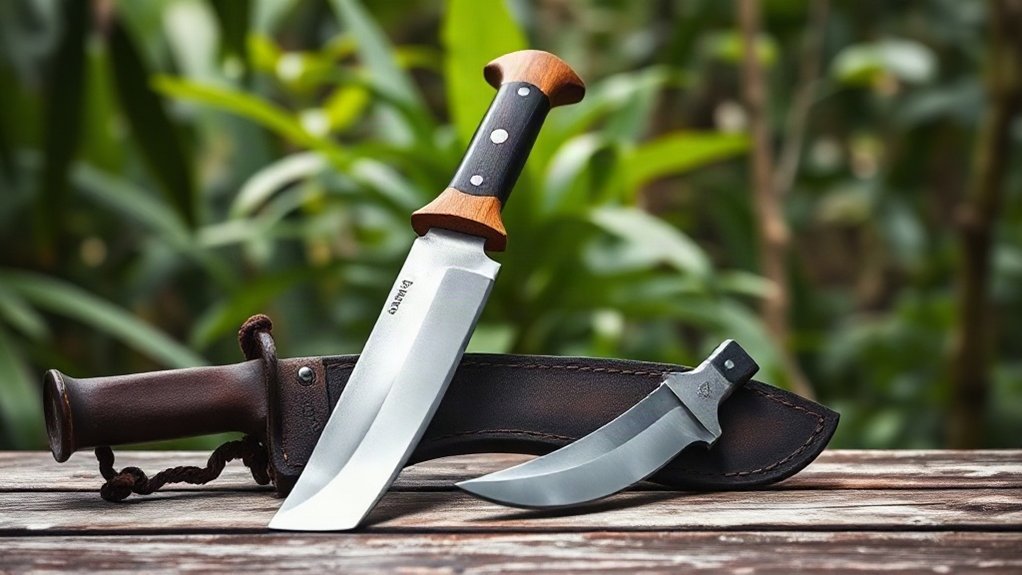
I’d choose a machete for reaching across broad brush and a kukri for controlled chopping in tight spaces. A machete usually has a longer, thinner blade that sweeps through grass, vines, and light growth. A kukri’s shorter, thicker, forward-curving blade concentrates weight near its belly, helping me chop branches and modest firewood. Machetes favor reach and repeated cuts; kukris favor compact power. I’d also weigh grip, balance, and the work ahead—the details can make either tool a better fit.
Key Takeaways
- Kukris have thick, inward-curving blades with forward-weighted bellies; machetes usually have longer, thinner, straighter or gently curved blades.
- Kukris typically have 10–18-inch blades and weigh about 400–700 grams; machetes commonly measure 14–24 inches and weigh roughly 300–500 grams.
- Machetes excel at sweeping cuts through grass, vines, and light brush, offering greater reach for broad-area trail clearing.
- Kukris suit compact, controlled chopping of branches, firewood, and small logs, especially where space is limited.
- Choose a machete for vegetation and reach, or a kukri for tougher wood and compact chopping; use an axe for demanding wood processing.
What Sets a Kukri Apart From a Machete?
A kukri’s inward-curving blade and forward-heavy balance set it apart from a machete’s longer, straighter, lighter design. That balance gives me strong chopping power in short, controlled swings, making a kukri useful for splitting wood, preparing camp materials, and tackling brush close at hand. A machete’s lighter handling and greater reach better suit fast, sweeping cuts across grass, vines, and broad areas of vegetation.
I wouldn’t treat either tool as a universal substitute for the other. I’d choose a kukri when compact chopping matters and a machete when sustained clearing gives me room to work efficiently. Their histories also carry meaning beyond outdoor tasks: traditional kukris are tied to Nepal and Gurkha heritage, while machetes grew as agricultural tools across tropical regions, including Latin America, the Caribbean, Africa, and Asia. That cultural symbolism connects each blade to regional identity and reminds me that freedom outdoors starts with choosing a tool suited to the work ahead.
How Do Their Blade Shapes Differ?
I’ll start with the kukri’s inward curve, broad forward belly, and raised point. A machete usually has a longer, straighter edge and a tip near the centerline. This contrast shapes how each blade delivers its cutting reach and force.
Kukri’s Forward Curve
How does a kukri’s blade shape differ from a machete’s? I see the kukri’s edge draw inward toward the handle, then sweep outward into a broad forward belly. This recurve geometry gives the blade a distinctive profile and places more mass near the cutting area. In use, that concentrated weight delivers strong chopping power with a compact swing, so you can work without needing a long, sweeping stroke.
The curve also supports controlled slicing, giving you flexibility between cuts. Its elevated point sits above the edge line, another visible feature of the kukri’s shape. Many Nepalese examples include a small notch near the handle, called a *cho*. Together, these details make the kukri a compact, force-focused tool for heavier cuts, while still offering useful control when you slice.
Machete’s Straighter Edge
By contrast, a machete usually has a long, straight or slightly curved edge designed for broad, sweeping cuts. I find this shape gives you reach and freedom to clear vegetation with fluid swings. Typical blades measure 14–24 inches long and 2–3 mm thick, balancing reach with a relatively thin profile.
| Blade | Edge geometry |
|---|---|
| Machete | Straighter; broad sweeps |
| Kukri | Recurved; forward belly |
That Edge geometry changes cutting mechanics: a machete favors sweeping cuts, while a kukri’s rounded belly concentrates weight near its cutting area. The kukri’s forward curve also places its point above the edge line; many Nepalese examples include a small base notch called a *cho*. Machete patterns vary by region and task, from straight to bolo-style and Latin designs, so you can choose a form that suits your work and preferred freedom of movement.
How Do Length and Weight Affect Handling?
Blade length and weight shape how each tool feels in motion: a kukri’s 10–18-inch blade and forward-heavy balance concentrate force near its curved belly, helping you deliver powerful, controlled chops. I find that extra weight can feel less nimble during fine movements, while a machete’s longer blade may feel awkward in tight spaces.
A kukri’s forward-heavy balance delivers controlled chopping power but may feel less nimble than a machete in tight spaces.
- A typical kukri weighs about 400–700 g; a machete usually weighs roughly 300–500 g, though models vary. The kukri’s heft favors deliberate swings, but can increase swing fatigue.
- Machete blades commonly span 14–24 inches, giving you more reach. Their lighter, more evenly balanced feel can make repeated swings easier.
- I’d weigh carry comfort against reach and control before choosing. A shorter kukri may feel easier to manage in confined areas; a machete’s length can suit open ground, though it takes more room to maneuver.
Neither tool guarantees freedom from strain: your grip, pace, and the model’s balance all affect handling. Try the weight in hand before committing, and choose what lets you move confidently.
Which Blade Handles Brush and Wood Better?
I’d choose a machete to reach farther and clear broad areas of grass and light brush quickly. For chopping branches or firewood, a kukri’s forward-weighted blade delivers more force, especially in seasoned or knotty wood. I’ll compare these strengths to help you choose the right blade for the task.
Brush-Clearing Reach
For broad brush clearing, I’d choose a machete: its 14–24-inch blade reaches across grass, vines, and cane, while its light, relatively thin profile makes repeated cuts quick. That extended cutting reach gives me greater vegetation coverage with less repositioning, especially when I’m opening a path or reclaiming a wide patch of land. A kukri’s shorter blade can feel more controlled in tight spaces, but it won’t sweep as much brush per stroke. I’d weigh the choice this way:
- Wide areas: I take the machete for faster clearing across lowland brush.
- Tight spots: I favor the kukri when I need controlled cuts around obstacles.
- Long sessions: I choose the lighter, longer machete to keep repeated swings efficient.
For freedom to move through overgrowth, I’d carry the machete.
Wood-Chopping Power
When the job shifts from clearing brush to chopping wood, I choose a kukri: its forward-curving belly concentrates weight for powerful, controlled strikes on branches, firewood, and small trees. That shape helps me deliver impact force with short swings, giving me control without needing a long run-up. Typical kukris measure about 10–14 inches and weigh 400–600 grams, enough heft to bite into seasoned or knotty wood. I watch the wood grain and adjust each strike to split or sever cleanly.
A machete’s longer, thinner blade excels at sweeping through grass, vines, and light brush, but dry wood can rob it of momentum or roll its edge. For chopping, I trust the kukri’s focused weight; it gives me a dependable tool for making camp and working freely outdoors.
Choosing for the Task
That chopping advantage makes the kukri a strong choice for wood, but the machete handles grass, vines, cane, and light brush more efficiently. I match my blade to the material selection and task prioritization, so I can work efficiently and stay in control.
- For wide, sustained trail clearing, I’d choose a machete. Its long, thin blade makes fast sweeping cuts and lighter handling can reduce fatigue.
- For firewood, branches, or thick brush, I’d take a kukri. Its forward-weighted curve concentrates impact, while its compact reach suits tight camps and mixed terrain.
- I’d check edge geometry before cutting: a thin machete edge suits vegetation, while a sturdier kukri edge handles tougher wood better. Seasoned or knotty wood can stop or damage a machete; neither blade replaces an axe for heavy processing. My choice lets me carry the right tool for the task.
What Makes a Kukri Suited to Camp Chores?
A kukri’s forward-curving, weight-forward blade concentrates force at its belly, so I can use short, controlled swings to chop firewood and small branches. Its thick spine and sturdy edge make kindling splitting practical, while the blade can trim poles for shelter building. These chores call for useful force, not elaborate technique, giving me a capable tool when I want to work independently at camp.
I also use a kukri to cut rope, prepare food, or handle coarse butchering. Its curve suits those general tasks, though I wouldn’t choose it for fine carving or skinning. For a balanced camp tool, I’d look at a medium model with a 10–14-inch blade; a heavier kukri adds chopping power but can feel less versatile. A kukri can stand in for a hatchet during light or medium chores, but I’d reach for an axe when heavy wood processing is on the list.
When Is a Machete Better for Trail Clearing?
For broad stretches of grass, vines, cane, and light brush, I’d choose a machete over a kukri. Its long blade, often 14–24 inches, reaches farther and sweeps quickly, helping me open more trail with less effort. That broad area efficiency matters when you want to move freely through dense growth rather than stop for every stem.
- Choose it for soft growth: In tropical vegetation or subtropical terrain, a machete cuts through abundant grass, vines, and light brush efficiently. A kukri’s concentrated weight is more useful for compact chopping and camp woodwork.
- Value comfort over long sessions: A relatively light, balanced machete makes repeated swings easier during extended trail maintenance, so I can keep clearing without tiring as quickly.
- Match blade and grip to the route: I’d pick a secure, non-slip handle and a blade suited to the plants. Thin blades handle brush well, but seasoned hardwood calls for another tool.
With the right machete, I can clear a path and keep moving under my own power.
How Do Kukri and Machete Construction Differ?
When I compare a kukri with a machete, I notice the difference in how each blade is built and balanced. A kukri usually has a thick spine and a forward-curving profile, with more weight near its belly. That mass helps me deliver powerful chopping strokes. A machete tends to be longer, thinner, and straighter or slightly curved; its lighter, more even build supports reach and repeated sweeping cuts.
Both tools may use carbon or spring steel, but forging and finishing vary widely. Traditional Nepalese kukris are often hand-forged, while machetes range from factory-stamped blades to locally forged versions. Modern survival kukris may feature Full tang construction, though traditional models can use other tang styles. I check the Heat treatment, edge thickness, and overall build rather than trusting a label. Steel quality and workmanship matter more than the blade’s name, giving me greater confidence to choose a dependable tool for the job.
How Do Their Handles Affect Grip and Control?
Beyond blade balance, handle design shapes how confidently I can control each tool. I look for secure handle ergonomics: enough room for my hand, a comfortable shape, and a surface that stays grippy when wet or dirty. That wet weather traction matters when I’m working outdoors and want dependable control.
- Kukri: Its weight-heavy blade pulls strongly forward during a chopping swing. A stable, well-shaped handle helps me resist that pull and guide the blade with control.
- Machete: Repeated sweeping cuts can tire my hand during extended clearing. A non-slip grip helps me keep the tool secure as I work.
- Either tool: I check that the handle feels comfortable and remains stable in use. A lanyard hole offers another retention option, but it can’t fix a poor shape or insecure fit.
I also wear gloves to support my grip and protect my hands. With these checks, I can choose a handle that supports confident, comfortable work.
Where Did Kukris and Machetes Originate?
The kukri traces its origins to Nepal, where people developed it as a practical tool for farming, woodcutting, and food preparation. Those Nepalese household origins explain its place in everyday life before it became a recognized symbol of Nepalese heritage. I see its history as one of practical independence: people shaped a tool around the work their homes and farms required. The kukri later became closely linked with Gurkha soldiers. Wider recognition followed the Gurkha War of 1814–1816 and grew through the World Wars.
The machete has broader tropical agricultural roots, developing across Central and South America, the Caribbean, Africa, and Asia. Its Spanish name spread with its use in farming and clearing sugarcane, vines, and brush. I find that regional history matters: machete patterns differ, and some English-speaking Caribbean communities call similar tools cutlasses. Both blades emerged from local needs, shaped by the communities that used them and by the freedom to meet daily demands with practical tools.
Which Blade Fits Your Outdoor Tasks?
I’d choose a kukri for compact chopping and camp tasks, where its forward-curved blade packs force into a short swing. For clearing grass, vines, and brush, I’d reach for a machete’s longer blade and sweeping cut. I’ll compare how each handles heavier wood, broad vegetation clearing, and precise camp work—and where a knife or axe fits better.
Heavy Chopping Power
When your task calls for heavy chopping, a kukri’s forward-curving blade puts weight near its belly, delivering strong force in a short, controlled swing. I’d choose it when you want compact power and room to work independently. Its substantial spine and forward balance improve chopping force through practical impact mechanics, making it better suited than most machetes for splitting firewood, cutting branches, and processing small logs.
- Firewood: A kukri can split modest pieces with controlled strikes.
- Branches: Its weight helps you cut through thicker limbs.
- Small logs: It handles compact camp jobs more effectively than a thin machete.
A machete gives you reach and handles light brush, but it generally won’t chop as deeply. For heavy wood, I’d take the kukri; neither blade replaces an axe for demanding processing, especially on seasoned or knotty wood.
Extended Vegetation Clearing
For sweeping through grass, vines, cane, and light brush, I’d choose a machete: its long, relatively thin blade reaches farther and handles repeated cuts well. That reach lets me clear a trail or open a wide patch without constantly repositioning. A balanced or slightly forward-weighted design supports Repeated swing endurance, so I can keep working through soft growth over a larger area. For broad area efficiency, especially in tropical or subtropical terrain, the machete usually moves faster than a kukri.
I’d choose a kukri when the brush gets close and compact, or when my workload includes chopping small limbs and wood. Its shorter, forward-curved blade delivers strong chops, but offers less reach for sweeping. Match the tool to your terrain and workload: pick the machete for sustained, wide clearing and the kukri for tighter spaces.
Precision Camp Tasks
At camp, I usually reach for a kukri for controlled tasks like food prep, carving, or cutting small materials. Its shorter, forward-curved blade concentrates force, giving me better carving control than a long machete. For Food preparation, a small kukri handles simple kitchen and utility jobs; a medium model, usually with a 10–14-inch blade, balances camp processing with chopping.
- I choose a kukri when I need compact, controlled cuts and a comfortable grip.
- I use a machete to clear grass, vines, and brush, not for detailed carving.
- I avoid either blade for skinning or delicate work: the kukri’s weight and curve can hinder precision, while a machete feels unwieldy.
I keep a clear swing path and never cut toward my body. My task decides which blade earns its place.
Frequently Asked Questions
Is a Kukri Better Than a Machete?
Neither is universally better; I’d choose based on your task and terrain. A kukri’s forward-curved blade and Blade weight distribution concentrate force, improving chopping efficiency for firewood, kindling, and small limbs. A machete’s longer, lighter blade gives you more reach and suits fast, repeated cuts through grass, vines, and brush. For broad clearing, I’d take the machete; for compact chopping and mixed camp jobs, I’d choose the kukri.
Can a Kukri Be Used as a Machete?
Yes, you can use a kukri as a machete to clear brush, vines, and small branches. I find its forward-heavy design effective for compact chopping, and Kukri blade curvature advantages include powerful cuts through tougher growth. Use controlled kukri chopping techniques, since the curved, weighty blade needs careful handling. Its shorter reach makes it less efficient for sweeping large areas of grass or light vegetation, where a longer, lighter machete gives you more freedom and speed.
Is Owning a Machete Illegal?
Owning a machete isn’t universally illegal; I’d check your local regulations before buying one. One useful distinction: U.S. air travel generally bans knives from carry-on bags, while securely sheathed or wrapped blades may go in checked baggage. Legal ownership at home can differ from carrying or transporting a machete in public, where rules may restrict concealment, blade length, or purpose. I’d verify current laws where you live and travel so you can make informed choices.
What Were Machetes Designed For?
Machetes were designed mainly for agricultural clearing: farmers used them to cut sugarcane, harvest crops, and clear grass, vines, and light brush. I’d describe them as practical tools for jungle management, where a long, light blade helps you make quick, repeated cuts and move freely through dense growth. Regional designs vary, but most machetes prioritize reach and speed over heavy chopping. They can tackle small woody growth, though seasoned hardwood isn’t their strength.
Conclusion
I choose between a kukri and a machete by matching the blade to the work. For long, light swings through grass and thin brush, I prefer a machete. For chopping, splitting kindling, and varied camp chores, I reach for a kukri’s forward-heavy blade. Which tool suits your next trip? Consider the vegetation, wood, and tasks you’ll face, then choose a comfortable, well-made blade and use it safely. The right design makes outdoor work more efficient and controlled.