Which Machetes and Kukris Are Better for Clearing Thick Brush?
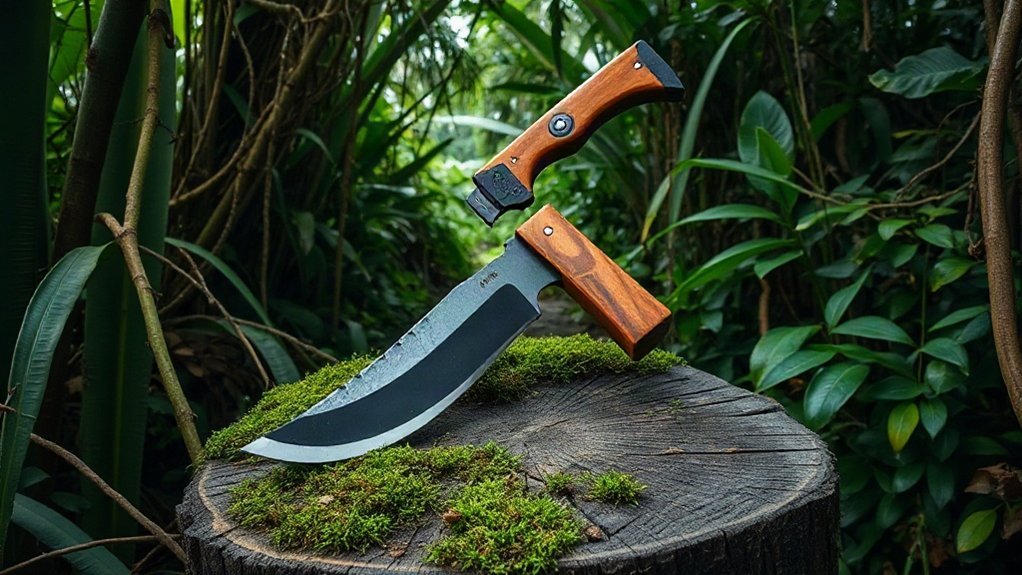
For thick brush, I’d choose a forward-weighted bolo or bush machete for woody stems over ¾ inch, and a kukri for saplings or dry hardwood that makes a thin blade bounce. A kukri or heavy bolo can handle stems around 3–4 inches, but I’d switch to loppers or a pruning saw for anything thicker. For vines and lighter growth, a lighter Latin machete is easier to swing. The right choice depends on your brush, space, and time in the field. Further details can help you choose confidently.
Key Takeaways
- Choose a forward-weighted bolo or bush machete for woody stems thicker than ¾ inch; its momentum improves chopping power.
- A kukri’s recurved blade helps cut saplings, dry hardwood, and woody stems that may make thin machetes bounce or bind.
- For dense brush and medium hardwood, consider the 18-inch, 24-ounce Cold Steel Barong; its downturned grip supports forceful swings.
- The 13-inch Cold Steel Kukri suits woody stems and saplings; a Condor Mountain Pass offers a heavier build for aggressive clearing.
- Use loppers or a pruning saw for stems over about 3–4 inches, and choose a secure, non-slip grip for control.
Which Blade Style Clears Thick Brush Best?
For dense brush with woody stems over ¾ inch, choose a forward-weighted bolo or bush machete; its extra chopping momentum outperforms a thin Latin-style blade. I’d match your blade to vegetation density, because the right tool lets you clear efficiently without fighting each stem. A Latin machete still earns its place for grass and light green growth, but it can bounce off thick, woody brush.
For saplings and dry hardwood, a kukri’s recurved tip concentrates force where you need it. Heavy bolos and kukris can handle saplings about 3–4 inches in diameter; for larger stems, I’d switch to loppers or a pruning saw. Your cutting technique matters, too: use controlled, committed chops, keep a stable stance, and make sure your swing has a clear path. Parang and golok styles suit wet tropical vegetation better than common North American brush such as alder, hawthorn, and autumn olive. Choose a blade that fits your terrain, and you’ll work with greater control and independence.
When Should You Choose a Kukri for Brush?
Choose a kukri when your brush includes woody stems, saplings, or dry hardwood that a thin machete struggles to cut. Its recurved blade concentrates chopping force where it lands, helping you cut through tougher material with fewer wasted strikes. Dry wood and thick limbs are where I’d reach for a kukri rather than a light, thin machete.
I also look for secure Swing control before committing to forceful cuts. The Cold Steel Kukri’s forefinger rest and contoured grip help keep my hand in place, so I can direct each swing with confidence. A kukri or heavy bolo can handle saplings around three to four inches in diameter; for larger stems, I’d choose loppers or a pruning saw instead.
For long hours clearing vines, weeds, and lighter brush, I’d pick a lighter machete. A kukri’s extra weight can tire your arm, so match the tool to the work and keep your freedom to move.
Which Machetes Cut Heavy Brush and Saplings?
For heavy brush and saplings, I’d choose a forward-weighted bolo or kukri, whose chopping momentum handles woody stems better than a thin Latin blade. A heavy model can cut saplings up to about 3–4 inches thick; beyond that, you’ll work faster with loppers or a pruning saw. I’ll compare options such as the Cold Steel Barong, Cold Steel Kukri, and Condor Mountain Pass.
Heavy Brush Choppers
Heavy brush calls for more than a light, straight machete: I’d reach for a forward-weighted chopper to cut woody stems and saplings with fewer swings. For vines, dense brush, and medium hardwood, the Cold Steel Barong pairs an 18-inch, 24-ounce 1055-carbon-steel blade with a downturned handle that helps me keep control. A kukri’s forward curve concentrates force; I’d consider the Cold Steel Kukri for thick vegetation. The Condor Mountain Pass, with its 15.57-inch 1075-steel blade and heavier build, suits aggressive clearing. For broader reach and small trees, the Condor Golok adds power, though its large handle may tire me during long sessions. When stems top about ¾ inch, a bolo hits harder than a light Latin-style blade. I keep up blade maintenance and use protective storage for safer, freer work.
Sapling-Clearing Picks
Once brush gives way to saplings, I favor a kukri or a heavy, forward-weighted bolo over a thin Latin-style machete; the added weight drives more force into woody stems. For stems up to about 3–4 inches, that extra bite can save effort and keep your work moving. The Cold Steel Kukri’s 13-inch recurved 65Mn spring-steel blade focuses force on woody stems. For broader reach, the Cold Steel Barong pairs an 18-inch, 24-ounce 1055 carbon-steel blade with hatchet-like chopping power. The Condor Mountain Pass adds a 15.57-inch 1075-steel blade and extra weight for aggressive cuts. Choose by sapling spacing and the freedom to maneuver safely. For thicker stems, switch to loppers or a pruning saw; they’re more efficient and support deliberate regrowth management.
When Does a Kukri Beat a Machete?
I reach for a kukri when I’m cutting woody stems and saplings rather than sweeping through light brush. Its forward-curving blade focuses chopping force near the tip, giving me more impact on thicker stems than a light, straight machete. I’ll compare where that focused power helps—and when a machete is still the better choice.
Woody Stems and Saplings
On woody stems, a kukri’s forward-curved blade concentrates force near the tip, giving it more bite than a thin, Latin-style machete. I choose a kukri or heavy bolo once stems exceed about ¾ inch; it can handle saplings 3–4 inches across. Read the woody stem grain and consider sapling regrowth patterns before cutting, so you can clear selectively and keep control of your land.
| Growth | Better choice | Why |
|---|---|---|
| Under ¾ inch | Light machete | Less tiring |
| Dry hardwood | Kukri | Less bounce or binding |
| ¾–4 inches | Kukri or bolo | Handles thicker stems |
| Over 3–4 inches | Loppers or saw | More efficient |
A heavier kukri may tire me during long sessions on light brush. For larger limbs, I switch to loppers or a pruning saw rather than force either blade.
Focused Chopping Power
For woody stems and saplings, a kukri beats a thin, straight machete when you need focused chopping power. Its forward-curving blade creates impact concentration near the contact point, helping you drive a cut through dense, dry wood. I’d choose a 13-inch Cold Steel Kukri for saplings and North American hardwood brush; its recurved profile suits that work better than a Latin machete, which excels in grass and light green growth.
For stems up to about 3–4 inches thick, a kukri or heavy bolo can deliver useful force. A kukri may also help when you need one stroke cuts through a limb, since a thin machete can bind. For larger stems, I’d reach for loppers or a pruning saw. The trade-off is weight: repeated swings tire me faster.
Which Machetes Handle Light Brush Best?
When you’re clearing grass, vines, and other light growth, a Latin-style machete is often the best fit: its long, thin, straight blade makes quick work of sweeping cuts. I find this design easy to guide along fence lines and through brambles, leafy growth, and thin green stems. A smooth grass cutting technique lets you clear efficiently without turning the task into heavy chopping.
For open ground, the 18-inch Tramontina offers a lightweight, effective choice, but it isn’t made for felling trees or processing wood. If you’re working in a smaller yard or tight spaces, a 14–16-inch blade gives you more control; that’s useful for compact yard control without sacrificing light-brush performance.
For longer sessions, I’d consider the Gerber Gator, with its rust-resistant 420HC blade and comfortable rubber-overmold handle. On a budget, the Imacasa Latin Machete costs about $15–$22 and handles grass, light brush, and fence-line clearing. Pick the tool that suits your space and work.
How Long and Heavy Should Your Machete Be?
How long should your machete be? I’d start with an 18-inch blade: its reach and control make it a versatile choice for clearing around home. Your ideal blade length depends on the terrain and workload, though. Choose freely based on where you’ll swing and how long you’ll work.
- In tight spaces, I’d use a 14–16-inch machete for easier control.
- For large volumes of brush, a 20–24-inch blade reaches farther, but may increase shoulder fatigue.
- During long sessions, I’d favor a lightweight, well-balanced machete to ease the strain of repeated swings.
- For woody North American brush, I’d look for at least 3 mm of blade thickness. Thinner 2–2.5 mm stock slices well but may flex.
Machete weight also affects chopping. A forward-weighted bolo or kukri brings extra momentum through thick brush, but that added heft can tire you over time. I’d match the tool to the job, not just the toughest-looking option.
What Makes a Machete Handle Secure?
A secure machete handle should stay put in your hand, especially when it’s wet or you’re swinging hard. I look for Wet grip handle materials, such as non-slip rubber or synthetic grips, so rain and sweat don’t compromise control. A contoured shape, like the Cold Steel Kukri’s, helps keep my hand in place while chopping.
| Handle feature | What I look for |
|---|---|
| Grip material | Non-slip rubber or synthetic |
| Contour | A shape that resists hand movement |
| Down-turn | The Cold Steel Barong’s polypropylene grip supports forceful swings |
| Rail and stop | A rail guides placement; a substantial stop limits creep |
A thumb or finger rail, as on the Condor Bushcraft Parang, can help me find a steady position without fuss. Check the hand stop design, too: during extended use, the ESEE Expat Darien’s grip may let your hand creep toward the blade. I’d choose a secure stop for confident, independent swings.
Which Machete Fits Your Trail Work?
Which machete fits your trail work depends on what you’re cutting. I match the blade to the trail terrain and clearing frequency, so you can move freely without carrying more tool than the job demands.
- For grass, vines, brambles, and small limbs, I’d choose a lightweight 16–18-inch Latin machete. Its straight blade reaches ahead and sweeps quickly.
- For woody stems over ¾ inch, I’d pick a forward-weighted bolo or bush machete; extra momentum makes chopping easier.
- For saplings and dry hardwood brush, I’d reach for a kukri. Its recurved edge concentrates force, and a heavy model can handle stems about 3–4 inches thick.
- In tight spaces or for occasional chores, I’d use a 12–14-inch blade. For all-day clearing, I’d prefer a full-size tool.
I also weigh comfort against impact: heavier blades hit harder, while a lighter, secure grip can help reduce fatigue through hours of swinging.
Frequently Asked Questions
Which Machete Is Best for Clearing Heavy Brush?
For heavy brush, I’d choose the Condor Mountain Pass: its forward-weighted 15.57-inch 1075-steel blade delivers strong chopping power on woody stems and saplings. I’d also check Machete Blade Length and Handle Grip Comfort before buying, since reach and secure control matter during long clearing sessions. The Cold Steel Barong is a powerful alternative for vines and medium hardwood. For stems over four inches, I’d switch to loppers or a pruning saw.
What Are the Best Tools for Clearing Thick Brush?
For thick brush, I’d choose a forward-weighted bolo or panga for stems over ¾ inch, a heavy kukri for saplings and dry hardwood, and loppers or a pruning saw for larger limbs. A heavy kukri can tackle stems around 3–4 inches thick—a useful limit to keep in mind. I’d plan Trail Maintenance Planning around the vegetation, wear Brush Clearing Safety Gear, and pick a comfortable handle so you can work freely without tiring too soon.
Is a Kukri Better Than a Machete?
A kukri’s better for heavy chopping, while a machete’s better for lighter, faster clearing. I’d choose based on the work you want to tackle: Kukri chopping power helps cut woody stems and saplings, whereas machete swing speed and reach make grass, vines, and briars easier to clear over long sessions. You’re free to choose the tool that suits your terrain; for larger stems, I’d reach for loppers or a pruning saw instead.
What Is the Best Way to Clear a Heavy Brush?
I clear heavy brush in stages: a 16–18-inch, 3 mm-thick blade handles most growth, while loppers or a pruning saw tackle larger stems. For woody brush, I choose a kukri; for dense, heavy stalks, I use a forward-weighted bolo. During Site preparation, I clear a safe swing path and wear eye protection and cut-resistant gloves. I bundle cuttings for Brush disposal. A sharp edge saves effort, so I touch it up every 45–60 minutes.
Conclusion
I choose a kukri when thick, woody brush calls for concentrated chopping power; I reach for a longer machete when I need faster swings through lighter growth or saplings. The best tool depends on the plants, your reach, and how long you’ll work, so there’s no single winner. Worried that a kukri is too specialized? A well-balanced model can handle varied trail chores, too. I’d prioritize a secure grip, manageable weight, and a blade you can control safely.